

Why Most Coaching Cycles Stall at Week Three
If you've coached teachers for any length of time, you probably know this pattern.
Week one feels great. You and the teacher sit down, talk through what's happening in their classroom, and land on a goal.
Week two is still solid. You get into the classroom, you model something or co-teach, you debrief.
Then week three happens.
If you've coached teachers for any length of time, you probably know this pattern.
Week one feels great. You and the teacher sit down, talk through what's happening in their classroom, and land on a goal. There's energy in the room. The teacher is interested, maybe even a little excited, and you leave thinking this could be a good one.
Week two is still solid. You get into the classroom, you model something or co-teach, you debrief. The teacher tries a few things. You're both still showing up on time.
Then week three happens. The teacher emails that morning to ask if you can push the debrief to next week. There's a data meeting, or a parent conference, or a sub shortage and they're covering a class during their planning period. You reschedule. Next week something else comes up. By week five, you're not really in a coaching cycle anymore. You're just two people who used to meet.
Nobody decided to stop. Nobody was unhappy with how it was going. It just faded out.
This happens so often that a lot of coaches start to treat it as normal. It shouldn't be. When coaching stalls, the teacher loses support right at the point where the work was about to get useful, and the coach loses the chance to see whether anything they did actually made a difference for students. It also quietly teaches everyone on campus that coaching is optional, something that happens when things are calm, which in a school is almost never.
The good news is that the week-three stall is usually predictable, and most of the causes are things you can plan around.
What's actually going on in week three
It helps to understand why the drop-off lands where it does. In my experience, it's rarely one thing. It's a few things that pile up at the same time.
The novelty wears off. Starting something new has its own energy. The first meeting feels like a fresh start, and teachers often come in hopeful. By week three, the work has shifted from talking about change to actually doing it, and doing it is harder. The teacher is trying something unfamiliar in front of real students, it isn't going smoothly yet, and the early excitement doesn't carry them through that.
The goal was bigger than anyone realized. A lot of cycles start with a goal like "improve student engagement" or "strengthen small group instruction." Those sound reasonable in a planning meeting. But they're so broad that there's no clear finish line and no clear way to tell if you're making progress. By week three, the teacher can't point to anything that's different, so it starts to feel like effort without payoff.
The coach has been doing most of the work. Early in a cycle, coaches often carry a lot of the load. They model the lesson, bring the resources, suggest the moves. That's fine at the start. But if the teacher hasn't taken over much of the work by week three, the cycle starts to feel like something the coach is doing to the classroom instead of something the teacher owns. And when the teacher doesn't feel ownership, it's easy for them to let it slide.
The feedback gets real. The first couple of debriefs tend to be pretty comfortable. There's a lot of "I noticed this went well" and "what did you think about that?" By week three, if the coach is doing their job, the conversation gets more honest. That's where growth happens, but it's also where some teachers start to feel exposed. Rescheduling is a very polite way to avoid a conversation you're not sure you want to have.
The rest of the school year shows up. Week three of a cycle that started in September lands right around progress reports, the first round of benchmark data, parent conferences, and whatever else your district has scheduled for October. Coaching is almost always the first thing to get moved because it feels like it can wait. A data meeting has a hard deadline. A coaching debrief doesn't.
None of these are about a bad teacher or a bad coach. They're about how the work is set up. That means the fixes are mostly about setup, too.
Start with a goal you can actually see
The single biggest change you can make is to narrow the goal. A good cycle goal should be small enough that you'd expect to see some change in two weeks, and it should describe what students will be doing, not just what the teacher will be doing.
Compare these two goals:
"Increase student engagement during math."
"By the end of the cycle, at least three-quarters of students will explain their thinking to a partner during the warm-up."
The first one is a direction. The second one is a target. With the second goal, you and the teacher both know what to look for when you walk in the room. You can count it. You can see it get better. And when it does, the teacher has something concrete to feel good about.
It can feel like you're thinking too small when you set a goal like that. You're not. A narrow goal that gets met builds momentum for the next cycle. A big goal that gets abandoned in week three just leaves the teacher feeling like coaching didn't work for them.
It also helps to write the goal in the teacher's words as much as possible. If the teacher says, "I want my kids to actually talk to each other instead of waiting for me to give the answer," that's a great starting point. Tighten it up together, but keep their language in it. People hold on to goals they helped write.
Put every meeting on the calendar before you start
Coaching cycles fall apart when each meeting gets scheduled one at a time. If the plan is "let's find a time next week," you're relying on both of you to find space in a week that will already be full.
At the first meeting, put the whole cycle on the calendar. Every observation, every co-teach, every debrief, all the way to the end. Pick times that are least likely to get eaten up. Planning periods on days without standing meetings. The same time slot each week if you can manage it, so it becomes a habit.
Then treat those times like you'd treat a meeting with your principal. If something has to move, move it within the same week, not to "sometime next week." One missed meeting doesn't kill a cycle. Two in a row usually does.
This sounds simple, and it is. It's also one of the most effective things you can do. A cycle that's already on the calendar has a much better chance of surviving October than one that has to be rebuilt every week.
Shift the work to the teacher on purpose
Most coaches know the idea of gradual release: I do, we do, you do. It's worth applying that to the coaching cycle itself, and being deliberate about it.
In the first week, it's fine for the coach to model and bring most of the materials. By the second week, you should be co-planning and co-teaching, with the teacher taking the lead on some parts. By the third week, the teacher should be running the lesson while the coach observes and collects evidence.
That shift matters because week three is exactly when ownership needs to be in place. If the teacher is leading the work by then, the cycle belongs to them. It's their goal, their lesson, their students. They're much less likely to cancel a debrief about something they're invested in.
It helps to talk about this plan openly at the start. Something like, "For the first week, I'll model this so you can see it. After that, we'll plan it together, and by week three you'll be teaching it and I'll be watching for what the kids are doing." That way the teacher knows what's coming and it doesn't feel like the coach is suddenly stepping back.
Look for an early win and point it out
Teachers need to see that the work is paying off, and they need to see it early. If the only proof of progress is supposed to show up at the end of a six-week cycle, most teachers won't make it that far.
Build in a small checkpoint around week two. Collect a few samples of student work, or do a quick tally of how many students did the thing your goal is about. Compare it to what you saw at the start. Even a small change counts.
Then make sure the teacher notices it. Sit down with the student work and point to specifics. "Look at these three kids. In the first week, they wrote one word. Now they're writing full sentences explaining how they got the answer." That's the kind of evidence that keeps people going. It's much more convincing than a general "things are going great."
If you don't see any change by week two, that's important information too. It might mean the strategy needs adjusting, or the goal needs to be smaller. It's better to learn that in week two and adjust than to push forward and have the cycle stall in week three with nothing to show for it.
Name the dip before it happens
One of the most helpful things you can do is tell the teacher at the beginning that week three is usually hard. Something like, "Around the third week, this usually starts to feel messier. The new thing isn't automatic yet, and it might feel like it's not working. That's normal, and it's actually right before things start to click."
When teachers know the dip is coming, it doesn't feel like a sign that they're failing. It feels like part of the process. And when it does show up, you can say, "Remember when I said week three would feel like this? This is it. Let's keep going."
This works the same way it does with students. When you tell a class that a new skill will feel awkward at first, they're more likely to push through the awkward part. Adults aren't much different.
Think about shorter cycles
A lot of coaching models use six-week cycles, and some go longer. There's nothing wrong with that, but it's worth asking whether every cycle needs to be that long.
A three- or four-week cycle with a tight goal can accomplish a lot. It also means you're finishing right around the time you'd otherwise be stalling. The teacher gets to see a complete cycle through to the end, reflect on what worked, and decide on a next goal. That sense of finishing something is valuable. It makes the next cycle easier to start.
If a teacher wants to keep going on the same goal, you can always extend it. But starting with a shorter commitment makes it easier for teachers to say yes, and easier to actually finish.
What campus leaders can do
Coaches can do a lot on their own, but whether coaching survives October often depends on what campus leaders do.
Protect coaching time. This is the biggest one. If coaches are regularly pulled to cover classes, run testing, or handle duties, their cycles will stall no matter how well they're planned. Some of that is unavoidable, especially with staffing shortages. But if coaching time is always the first thing sacrificed, teachers notice. They learn that coaching isn't a priority, and they treat it accordingly.
Keep coaching separate from evaluation. Teachers need to know that what happens in a coaching cycle isn't going to show up in their evaluation. If they think the coach is reporting back to the principal about their weaknesses, they won't be honest about what's hard, and the work won't go anywhere. Leaders can make this clear by saying it directly and by not asking coaches for information about specific teachers' performance.
Ask teachers about their cycles. When you see a teacher who's in a coaching cycle, ask them how it's going. Ask what they're working on and what they're noticing with their students. This tells the teacher that you care about their growth, and it keeps the cycle visible without putting the coach in an awkward spot.
Look at the calendar. If a lot of cycles are stalling in October, look at what's on the campus calendar that month. Sometimes a school has scheduled so many meetings, trainings, and data days that there's simply no room for coaching. That's a leadership decision, and it can be changed.
When a cycle stalls anyway
Even with good planning, some cycles will stall. A teacher will cancel twice in a row, or show up to debriefs without having tried anything, or seem checked out. When that happens, the worst thing to do is let it quietly fade away.
Instead, have a direct conversation. Keep it low pressure. Something like, "I've noticed we've had to move our last couple of meetings. I don't want this to feel like one more thing on your plate. What's going on, and what would make this more useful for you?"
Sometimes the answer is that the teacher is overwhelmed with something else, and the best move is to pause the cycle and set a date to restart. That's fine. A planned pause is very different from a cycle that just disappears.
Sometimes the answer is that the goal isn't something the teacher cares about. Maybe it came from a campus initiative, or it sounded good in the first meeting but isn't what they're actually struggling with. In that case, change the goal. It's much better to work on something the teacher is invested in than to push through on something they're not.
And sometimes the answer is that the teacher is uncomfortable with where the feedback is going. That's worth talking about honestly. You might say, "I know some of what we've been talking about is hard. That's usually a sign we're working on something that matters. How can I make these conversations feel more useful and less like a critique?" Giving the teacher more control over what gets observed and discussed can help a lot.
Whatever the reason, the conversation itself matters. It shows the teacher that the coaching relationship is worth protecting, and it gives you a chance to fix things before they're too far gone.
It's worth getting right
Coaching is one of the best tools schools have for helping teachers grow. It's personal, it's tied to real classrooms, and it happens over time instead of in a single afternoon of PD. But it only works if it lasts long enough to make a difference.
Week three is where a lot of that potential gets lost. Not because anyone gave up, but because the setup didn't account for how hard the middle of a change can be.
A narrow goal, a full calendar, a planned shift in ownership, an early win, and an honest heads-up about the dip will get most cycles through. And when one stalls anyway, a direct conversation can usually get it back on track.
The teachers you coach are going to hit the hard part either way. The goal is to still be in the room with them when they do.

TEA Updates Every Texas Educator Should Know
If you feel like there's more to keep up with this year than usual, you're not imagining it. The 89th Texas Legislature passed one of the more consequential education sessions in recent memory, and Texas Education Agency implementation of that session is now landing on campuses all at once.
This is a grounded rundown of what actually changed, what it means for your campus or classroom, and what's still unresolved.
If you feel like there's more to keep up with this year than usual, you're not imagining it. The 89th Texas Legislature passed one of the more consequential education sessions in recent memory, and Texas Education Agency implementation of that session is now landing on campuses all at once — a major school funding overhaul, a new statewide school choice program, new discipline authority, revised safety rules, new professional learning requirements for K-3 teachers, and a batch of classroom-conduct laws, all converging in the same school year. Add in this year's freshly released accountability ratings, and it's a genuinely dense start to 2026–27.
This is a grounded rundown of what actually changed, what it means for your campus or classroom, and what's still unresolved. It's organized so you can skim to the sections that apply to you rather than reading it as one long policy memo — though if you read straight through, you'll come away with a real picture of the year ahead.
2026 A-F accountability ratings are out — and mostly trending up
TEA released the 2026 A-F accountability ratings on August 14, covering more than 1,200 districts and charter systems and roughly 9,100 campuses statewide. The topline numbers are encouraging: about 85% of rated campuses earned a C or better, considered acceptable performance, and roughly a quarter of districts and campuses improved their letter grade from 2025. About 6% of campuses — 585 schools — improved enough to earn an A after posting lower grades previously, while about 8% landed at D or F.
The district-level picture is where it gets interesting. Houston ISD posted a district-wide B — its second consecutive B — and continued its recovery from the 2023 state takeover, with the number of campuses rated D or F dropping from 120 in 2023 to 13 this year. That said, the improvement wasn't a straight line: HISD had zero F-rated campuses in 2025 and four this year (Benavidez, Foster, Highland Heights, and Mading elementary schools) — worth knowing if your community is asking how the "turnaround" story and this year's new F ratings fit together. Wheatley High School, whose poor performance was the specific trigger for that takeover three years ago, earned its first-ever A rating in 2026. Dallas ISD earned its second straight B, and Northside ISD posted a C. Austin ISD earned a B overall but now faces a real threat of state intervention, since two of its middle schools (Burnet and Webb) posted their fifth consecutive F rating — a threshold that historically triggers closer state scrutiny or a board of managers.
If your campus rating shifted this year, it's worth digging into whether that reflects genuine instructional change, a demographic or enrollment shift, or a methodology adjustment — the accountability system has been the subject of ongoing legal challenges over the past several years, with districts suing over how the ratings are calculated, and those lawsuits have delayed release of ratings in multiple prior years before courts eventually cleared publication. That legal backdrop doesn't change your rating, but it's useful context if you're fielding questions from your board or your community about why the math seems to have moved under everyone's feet at some point in the recent past.
HB 2 reshapes school funding — and it's not just about raises
House Bill 2 delivered an $8.5 billion increase to public school funding, the first major boost after years of essentially flat per-student allotments. For classroom teachers, the headline is real raises — but the amount depends heavily on where you teach. Through the new Teacher Retention Allotment, teachers with 3–4 years of experience get $4,000 in districts with 5,000 or fewer students, or $2,500 in larger districts; teachers with 5+ years get $8,000 in smaller districts or $5,000 in larger ones. First- and second-year teachers don't receive a raise under this allotment. Since most Texas teachers work in districts above the 5,000-student threshold, most classroom teachers will see the lower end of that range rather than the top figure. Districts also gained a $55-per-student increase to the basic allotment for general operating costs, plus a separate $45-per-student Support Staff Retention Allotment aimed at the counselors, librarians, nurses, and other non-administrative staff who don't always show up in headline teacher-pay coverage but who keep a campus running day to day.
Underneath the raise numbers, HB 2 makes several structural changes worth understanding even if they don't show up in your bank account directly.
Special education funding is moving to an individual-needs model. Rather than funding special education based on instructional setting, TEA is implementing what's being called an Intensity of Services model, tying funding to tiers aligned with the actual level of service a given student requires. TEA published implementation guidance on this in April, and if you're in special education leadership or campus administration, this is worth a direct look — 2026-27 is a transition year in which districts report data under both the old and new systems, and the shift changes how staffing and service dollars get justified and tracked.
Teacher certification gets a direct financial incentive — for a specific group. Districts receive a one-time $1,000 payment for teachers who were hired as uncertified first-year teachers in 2022-23 or 2023-24, remained uncertified as of January 1, 2025, and go on to complete required preparation components and earn a standard certificate by the end of 2026-27. There's also reimbursement authority for districts covering certification costs in ten specified Career and Technical Education fields, retroactive to teachers certified on or after September 2025 — good news if you have CTE staff who've been working toward certification and wondering whether the district would help offset the cost.
Teacher vacancy reporting is new. Starting with the 2026-27 school year, districts have to report vacant teaching positions to TEA through a new Texas Student Data System core collection, covering vacancies that occur between September 1 and August 31 annually, with the first submission due in September 2027. If you're in HR or central office, expect this to land as a new recurring data task if it hasn't already been assigned to someone.
The Teacher Incentive Allotment gets a new tier — and more money behind it
If your district participates in the Teacher Incentive Allotment, there's a meaningful change worth knowing about. HB 2 introduces a new "Acknowledged" designation level starting in 2026-27 — roughly the top 50% of Texas teachers by the program's performance measures — sitting below the existing Recognized, Exemplary, and Master designations. Performance standards across designation levels were also updated based on 2025-26 performance data, so a teacher's path to a given designation this year may look somewhat different than it did last year even without a change in their actual performance.
The funding formula behind TIA changed too. Acknowledged designations pay $3,000 to $9,000 depending on campus factors, with higher amounts at the Recognized, Exemplary, and Master levels, plus increased multiplier amounts for the high-needs and rural school factors. Teachers currently holding a Recognized designation through National Board Certification are being moved to a new "Nationally Board Certified" designation with its own funding band, rather than folded into the general Recognized tier. TEA also says the application process itself is being streamlined, with expanded technical support available through your regional Education Service Center. If your district has been on the fence about building out a TIA program, or has one that's stalled, this is a genuinely better year to revisit it than most.
New literacy and numeracy screening requirements are phasing in for K-3
HB 2 also rewrites how early literacy and numeracy get assessed, and the rollout is happening in stages that are easy to misread if you only catch a headline about it. For 2026-27, districts are encouraged but not required to administer board-selected literacy and numeracy instruments — this is an interim, transition year. Kindergarten reading readiness assessment remains mandatory under existing law regardless, using one of two free, commissioner-approved tools (Circle Kindergarten Progress Monitoring or mCLASS Texas). For grades 1 and 2, TPRI/Tejas LEE and mCLASS Texas remain available at no cost, and districts can choose alternatives if they prefer. Universal dyslexia screening continues to be required for kindergarten and first grade this year, unchanged.
The bigger shift lands in 2027-28, when all K-3 students will need to be assessed using only instruments from a state-adopted, commissioner-approved list, with testing frequency increasing to multiple checkpoints across the year — beginning, middle, and end-of-year windows depending on grade level. In other words: 2026-27 is the year to get familiar with the tools and the direction things are heading, not the year everything becomes mandatory. Districts that use this transition year to pilot their instrument choice will likely have an easier 2027-28 than those that wait.
Paired with this is the new Texas Mathematics Academies program, a redesigned professional learning requirement of roughly 30 hours — two in-person days, three asynchronous modules, and ongoing virtual touchpoints with cohort leaders. By 2030-31, every K-3 classroom math teacher, along with principals, assistant principals, math instructional coaches, and math interventionists working at K-3 campuses, will need to complete it; new staff moving into those roles after that point will need to complete it within their first year. The 2026-27 school year is the pilot year, with districts gaining a local implementation option starting in 2027-28. If you're a K-3 math teacher or coach, there's no urgency to complete this immediately, but it's worth knowing it's coming and watching for your district's or ESC's pilot cohort openings if you'd rather get ahead of the eventual requirement than complete it under deadline pressure in a few years.
SB 2 launches Texas's first statewide school choice program
Senate Bill 2 opens Texas's new education savings account program this year, letting eligible families use state funds — $10,474 per student for 2026-27, roughly 85% of per-student public school funding, with up to $30,000 available for students with qualifying disabilities and $2,000 for homeschooling families — toward private school tuition and related educational costs. The program launches with a $1 billion budget that's projected to grow substantially, with some estimates putting it near $4.8 billion by 2030 as enrollment in the program scales up.
Whatever your personal view of the policy, the practical implication for public school leaders is straightforward: enrollment planning. This is the first school year where districts will actually be able to see, rather than project, whether and how much the ESA program shifts local enrollment, and by how much. If your district serves a community with meaningful private-school access nearby, this is worth tracking closely in your enrollment data this fall rather than assuming the impact will be negligible — early real numbers will tell you more than any statewide estimate can.
HB 6 expands schools' discipline authority — with real limits attached
House Bill 6 is one of the more substantial classroom-management changes this session, and it partially reverses discipline protections that were put in place in 2017 and 2019. Under the new law, in-school suspension no longer has a fixed time limit, though principals are required to review any extended ISS placement every ten days rather than leaving it open-ended. Out-of-school suspension remains capped at three days, as it was before — what changed is who it can be used on. The bill allows out-of-school suspension for students below third grade (pre-K through second grade) and for students experiencing homelessness — populations that were previously largely shielded from OSS — specifically in cases of "repeated and significant" classroom disruption or a threat to others' safety. Schools are required to document the disruptive behavior before suspending one of these younger students, so this isn't an unlimited return to earlier discipline norms; there's a documentation bar built in.
The bill also loosens the automatic consequences for first-time vaping violations, allowing schools to respond with something less severe than mandatory alternative education placement, and it gives disciplinary alternative education programs more flexibility to operate remotely — though it's worth noting that remote instruction in these settings has been associated with pandemic-era learning loss in the research cited around this bill, so "more flexible" doesn't necessarily mean "better outcomes" without careful implementation. If your campus handles a meaningful number of ISS or DAEP placements, it's worth getting clear guidance from your district on the new documentation and review requirements before you're navigating a specific case for the first time under the new rules.
The cell phone ban is now in its second year
HB 1481, which restricts personal wireless device use during the instructional day, took effect for the 2025-26 school year and continues now that districts have a full year of implementation behind them. If your campus is still refining enforcement — collection systems, exceptions for documented medical needs, consequences for repeat violations, how substitutes are expected to handle it — this is a good year to look at what other, similar districts landed on rather than reinventing the policy from scratch. A year of real-world data across the state means there's genuinely more to learn from than there was when the law first took effect.
New school safety rules are moving through adoption this year
TEA issued a substantial round of school safety updates in April, with several new or amended rules expected to be formally adopted for the 2026-27 school year. The most relevant for classroom teachers: updated drill requirements under Senate Bill 57 explicitly require that students and staff with disabilities have equal access to safety during required drills and emergency events. If your campus's current drill plan hasn't been reviewed with that specific lens, it's worth raising with your safety coordinator directly rather than assuming it's already been handled centrally.
Beyond drills, TEA introduced a multi-tiered monitoring framework for campuses with a history of safety findings, meant to increase accountability while also providing more technical assistance for campuses working to come into compliance. New rules also address safety provisions specifically for extracurricular activities — covering students, staff, and spectators within multihazard emergency operations plans — and TEA has established authority to assign a conservator to a school system that fails to comply with safety monitoring requirements, which is a meaningfully sharper enforcement tool than existed before. On the reporting side, districts are now required to submit emergency response information, including firearm discoveries and bomb threats, through the state's Sentinel portal, so if your campus hasn't been routing that kind of incident reporting through Sentinel yet, that's a gap worth closing now rather than after an incident occurs.
A few classroom-facing compliance items to have on your radar
A handful of new laws affect what's on your walls and in your daily schedule rather than your lesson plans directly, and they're worth knowing even if your district's legal counsel is the one building formal guidance around them. SB 10 requires public schools to display a durable poster or framed copy of the Ten Commandments, in specific dimensions and wording, in every classroom; the state didn't fund the mandate, so schools must rely on privately donated copies or local resources, and must accept any donated display that meets the law's specifications. The law has been in active federal litigation since shortly after it passed — a district court blocked enforcement in a group of districts in August 2025, a federal appeals court sided with the state in April 2026, and related lawsuits were still working their way through the courts as of this past summer — so check with your district on where your specific campus stands before assuming the requirement is settled either way. SB 11 permits, but doesn't require, a daily period for prayer or reading of religious texts, with parental consent required for student participation; districts decide individually whether to adopt it, and some large districts have already said they won't. SB 12 restricts consideration of race, ethnicity, gender identity, or sexual orientation in hiring decisions and bars school-sponsored clubs organized around those categories. SB 13 gives parents and school boards new, more formalized authority to challenge and remove library materials containing content they consider indecent or profane.
These are the kind of items where individual educators shouldn't be figuring out compliance on their own — they genuinely need district-level guidance, since implementation details and legal risk vary by how a given district chooses to apply them, and in SB 10's case, by where the ongoing litigation stands. If you haven't seen a memo or training on any of these yet, it's worth asking your administration directly rather than assuming someone else already has it handled, since the start of the year is exactly when gaps like this tend to surface unexpectedly.
Teacher pay and retirement: steady, with a few real wins
Outside of HB 2's raise money, a few other bills affect educator compensation and benefits worth knowing about, particularly if you're weighing retirement timing or comparing your health coverage options. Senate Bill 1 keeps the state's contribution to the TRS pension trust fund at 8.25% and maintains existing state and employer contributions to TRS-Care, while also directing TRS to produce a report to the Legislative Budget Board and the Governor, due by September 1, 2026, comparing the current defined-benefit pension plan against alternative plan designs; TRS's board reviewed preliminary work on that study at its April 2026 meeting, ahead of the formal report. It's worth watching if you're several years from retirement, since the report could shape future legislative proposals. House Bill 500 puts $369 million toward keeping the average TRS-ActiveCare premium increase below 10% for both FY2026 and FY2027, which is a direct, tangible cost-containment win for active employees on that plan. And House Bill 3126 opened a window — now closed — for entities that left TRS-ActiveCare back in 2022 to rejoin before their standard five-year exclusion period ended; the deadline to take advantage of that early-return option was December 31, 2025, so this is now mainly relevant as background if your district or a nearby one was among those that opted out at the time.
None of this amounts to a major pension overhaul, and there's no new cost-of-living adjustment for current retirees in this session's legislation. But the ActiveCare premium cap in particular is worth knowing about if you've been budgeting around steeper increases.
What changed with STAAR — and what didn't, yet
House Bill 4, which would have replaced STAAR with a shorter, different testing model, died in the regular session after the House and Senate couldn't agree on details like the commissioner's rulemaking authority and whether to keep a mandatory social studies test. But that's not the end of the story: lawmakers passed a separate bill, HB 8, in the special session that followed, and Governor Abbott signed it in September 2025. HB 8 eliminates STAAR for grades 3–8, replacing it with three shorter assessment windows across the year (beginning, middle, and end-of-year), while leaving most high school End-of-Course exams largely in place (English II EOCs are being phased out after the class of 2027). The change doesn't take effect until the 2027-28 school year, so STAAR as you know it is unchanged for 2026-27 — but the replacement is already law, not a maybe. If you were bracing for a testing overhaul on top of everything else this year, the honest version is: not yet, but it's coming, and it's already decided.
The throughline
None of this is exhaustive — TEA rulemaking continues year-round, and several of the items above, particularly special education funding and the safety rule adoption process, are still being finalized in detail as the year goes on. But there's a useful pattern underneath all of it: this is overwhelmingly a funding, structure, and oversight year rather than a curriculum year. The biggest changes are about how money flows, who gets reported to whom, and what authority schools and the state have over discipline and safety — not about what happens minute-to-minute inside your classroom on a given Tuesday. Assessment is unchanged for this specific year even though its replacement is locked in for 2027-28, and most of what's new is either administrative or, in the case of teacher pay and the TIA expansion, genuinely in educators' favor.
That's worth some real relief, even amid a longer list than usual to keep track of. The most useful thing you can do with all of this isn't to memorize every bill number — it's to know which two or three items actually touch your role directly, get clarity from your campus or district on those specifically, and let the rest sit as background awareness for now.
Sources & further reading:
TEA Releases 2026 A-F Accountability Ratings on TXschools.gov
Texas schools see modest improvement in 2026 A-F ratings — KERA News
HISD: 4Fs, More As and Bs and Special Ed Questions Continue — Houston Press
Wheatley High School earns an A rating for the first time — KHOU
Dallas ISD earns second straight B in TEA ratings — Dallas Morning News
Two Austin ISD schools receive fifth consecutive F rating — KXAN
HB 2: Understanding the Teacher Retention Allotment and Support Staff Retention Allotment — ATPE
House Bill 2 Implementation: CTE Certification Reimbursement to Districts — TEA
House Bill 2 Implementation: Teacher Certification Incentive — TEA
HB 2 Implementation: Teacher Incentive Allotment Update — TEA
HB 2 Implementation: Foundational Literacy and Numeracy Instruments — TEA
Texas to expand how schools discipline students — Texas Tribune
House Approves Controversial School Discipline Bill — Texas Policy Research
Legal Challenges to Texas' Ten Commandments Law, SB 10 — ACLU of Texas
School Districts Can Set Aside Prayer Time Under a New Texas Law. Few Have Done So. — U.S. News
With New Book Ban Law, Governor Abbott Signs SB 13 — Texas Freedom Network
2025 TRS-Related Legislation Summary — Teacher Retirement System of Texas
HB 4, a bill to get rid of the STAAR test, dies in the 89th legislative session — KWTX
Texas House Bill 8: Ending STAAR and What's Coming Next — ProgressLearning

The First Two Weeks: What Data Can't Tell You Yet
Somewhere in the second week of school, a screen will fill with numbers. A universal screener, a diagnostic, a beginning-of-year benchmark — whatever your building calls it, it will produce a tidy report sorting every student into a tier, a percentile, a color band. Someone will print it, or worse, project it, and a decision will start to take shape before anyone has learned to pronounce all the students' names correctly.
This is the moment worth slowing down on.
Somewhere in the second week of school, a screen will fill with numbers. A universal screener, a diagnostic, a beginning-of-year benchmark — whatever your building calls it, it will produce a tidy report sorting every student into a tier, a percentile, a color band. Someone will print it, or worse, project it, and a decision will start to take shape before anyone has learned to pronounce all the students' names correctly.
This is the moment worth slowing down on, because the number you get in week two is not the same kind of number you'll get in November, even if it comes from the identical assessment. Early-year data carries a specific, predictable kind of unreliability that has almost nothing to do with the quality of the test and almost everything to do with the fact that it's being given to children who, two weeks ago, weren't thinking about school at all.
Why the First Data Point Lies a Little
Start with the most obvious issue: summer isn't uniform. Every student in a classroom just spent eight to eleven weeks doing wildly different things with their brain. Some read every day. Some didn't open a book. Some practiced math facts in a workbook their family bought; others spent the summer in a different language environment entirely, or moving between households, or working. A beginning-of-year score doesn't just measure a student's skill — it measures skill plus however much of it eroded, sharpened, or sat untouched over the break, and that erosion isn't evenly distributed. Two students who ended last spring at the same level can show up in August looking like they belong in different tiers, not because their underlying ability diverged, but because their summers did.
Then there's the format problem. Any assessment, no matter how well designed, has a learning curve of its own — how directions are phrased, how the interface works if it's on a screen, how much time pressure there is, what kind of stamina it demands. A student who hasn't touched this particular test since last spring, or is meeting it for the first time in a new grade, is spending part of their cognitive effort on figuring out the test itself, not just answering it. That's not a flaw specific to bad tests; it's a flaw specific to any test given cold, without recent practice, to someone who doesn't yet know what to expect. The score that comes out the other end is a blend of ability and unfamiliarity, and there's no clean way to separate the two after the fact.
Add to that the plain fact that most students in the first two weeks are not fully themselves. They're sizing up a new room, a new adult, sometimes new classmates. Anxiety runs higher than it will in October. Some students are testing whether this teacher is someone worth trying for; a few, especially ones who've had a rough history with school, are quietly deciding how much effort is safe to invest before they know how this year is going to go. None of that shows up as a footnote on the score report. It just shows up as a number that looks lower — or occasionally higher, from a student overcompensating with nervous effort — than what that student can actually do once they've settled in.
Put those three things together — uneven summer drift, format unfamiliarity, and elevated anxiety — and you get a measurement with a wider error band than the same test would produce in November. Statisticians would call this reduced reliability at that particular administration. Teachers call it "trust your gut for a few more weeks," and they're not wrong to.
The Trap of Early Certainty
The danger isn't that early data exists. It's that early data tends to get treated with the same confidence as data collected later in the year, because a report doesn't come with a disclaimer that says this number is noisier than it looks. A percentile is a percentile whether it's captured in week two or week twenty, and once a student is sorted into an intervention group, a reading level, or a "watch list," that placement has a way of sticking. Schedules get built around it. Small groups get formed around it. And group placements, once made, are logistically annoying to unwind — so even when a teacher notices by October that a student doesn't belong where the September data put them, inertia is working against the correction.
This is how a student can spend a whole semester in the wrong intervention group: not because anyone made an obviously bad call, but because a slightly noisy data point from the second week of school got treated as settled fact, and nobody built in a deliberate moment to re-check it once the noise had cleared.
There's a second, quieter version of this trap, which is emotional rather than logistical. A low early score can shape how a teacher talks about and to a student before the teacher has any independent basis for that read. It's hard to fully unhear a number. A teacher who's told, before she's spent a single instructional day with a class, that three students are "significantly below benchmark," will — even trying hard not to — watch those three students slightly differently than she'd have watched them cold. Expectation effects in classrooms are well documented, and they don't require any bad intent to operate. They just require an early label and a busy year that doesn't leave much room to double-check it.
What Early Data Is Actually Good For
None of this is an argument for skipping beginning-of-year assessment. It's an argument for being precise about what it's for. Early data is genuinely useful as a coarse screen — a way of flagging students who might need a closer look, not a way of making fine-grained placement decisions. If a screener flags a student as dramatically behind grade level, that's worth investigating regardless of how noisy the measurement is, because the cost of missing a student who truly needs support outweighs the cost of a false alarm. Early data earns its keep as a net that catches the students at the extremes.
Where it gets shaky is in the middle — the wide band of students who score somewhere in the ordinary range, where a few percentile points of noise can flip a placement decision that shouldn't be made on a single data point in the first place. That's exactly the group where teacher observation over the first couple of weeks tends to be more informative than the test, not less, because the observation is compounding, day after day, in a way a single test administration can't.
What to Trust Instead, for Now
If the first data point is noisy, the honest response isn't to have no information for two weeks — it's to gather a different kind, one that's more resistant to the specific distortions early testing runs into.
Watch how students engage with routine, not just content. In the first days, before instruction has really ramped up, you learn an enormous amount just from how a student handles transitions, unstructured time, and low-stakes tasks. Do they ask for help when stuck, or shut down? Do they need the directions repeated, or do they read the room and follow along? This isn't academic data in the narrow sense, but it's a strong predictor of how a student will access instruction once it starts, and it's much less contaminated by summer rust or first-week nerves than a cold benchmark score.
Use low-stakes, high-frequency checks instead of one high-stakes snapshot. A quick informal reading conference, a math warm-up with two or three problems, a one-paragraph writing sample done without pressure — none of these carry the weight of a formal benchmark, but stacked across the first ten school days, they build a much richer and more stable picture than a single test sitting does. The point isn't to replace the benchmark with something softer; it's to let the accumulation of small, repeated observations do the job that a single measurement can't do well this early — average out the noise.
Pay close attention to the gap between a student's independent work and their work with support. Especially in the first two weeks, effort and confidence are doing a lot of the driving, and the clearest way to see past that is to watch what happens when you sit next to a student and work alongside them for two minutes. A student who can do far more with a little scaffolding than they show independently is telling you something a test can't: that the skill is more present than the anxiety is letting on. A student who doesn't improve much even with direct support is telling you something different, and arguably more diagnostically important than either version of them cold.
Notice what students choose when nobody's grading it. Independent reading time, choice-based tasks, free-response prompts — these reveal preference and stamina in a way testing conditions never will. A student who picks up a book during free choice time and stays with it for fifteen minutes is showing you something about their relationship to reading that a comprehension benchmark, administered under time pressure on day three, simply isn't built to capture.
Talk to last year's teacher, but hold it loosely. A five-minute conversation with a student's previous teacher can shortcut a lot of guessing — but it comes with its own version of the labeling risk described above. The most useful version of this conversation asks about patterns and conditions ("what helped him focus," "what she struggled with in groups") rather than verdicts ("he's not a strong reader"), because patterns transfer between school years and verdicts don't always deserve to.
Building in a Deliberate Re-Check
The single most useful structural fix a school can make isn't choosing a better beginning-of-year assessment — it's building a deliberate point, roughly three to four weeks in, where every early placement gets revisited on purpose, with fresh evidence, rather than left to persist by default. This doesn't have to be elaborate. It can be as simple as a short protocol: for every student flagged by the early screener, has classroom observation over the past three weeks confirmed or complicated that flag? For every student the screener missed but a teacher has flagged informally, is there now enough evidence to act on it?
This re-check matters more than people tend to think, because the alternative isn't neutral — it's not "no decision gets made." Decisions get made anyway, by default, based on whatever placement the early data produced, simply because nobody scheduled a moment to reconsider it. Building the re-check into the calendar, rather than hoping someone remembers to raise it, is what actually protects against the noisy early snapshot hardening into a full-year label.
The Two Weeks Are Data Too
It's worth ending on the thing that's easy to lose in all of this: the first two weeks aren't a gap in the data. They're a different kind of data — slower to quantify, harder to put in a spreadsheet cell, but not less real than a benchmark score. A teacher who spends those two weeks watching closely, without rushing to sort students into permanent categories, isn't avoiding data-driven practice. She's collecting the kind of data a screener can't, at exactly the moment when the screener is least equipped to be trusted on its own.
The number will still get printed. The dashboard will still get projected. But the most useful thing a school can do with a beginning-of-year benchmark is treat it the way you'd treat a first impression of a new colleague — worth noting, worth taking seriously if it's extreme, and absolutely worth revising once you've actually spent some time in the room together.

HB 8 and What It Means for Math Instruction in Texas
STAAR is on its way out. Beginning in 2027–28, Texas students will take three shorter, smarter math assessments spread across the school year. Here's what that shift means for teachers, campuses, and kids.
After years of frustration — from teachers spending weeks on test prep, to students receiving results too late to matter, to communities questioning whether one high-stakes spring exam could ever capture what a school does well — Texas finally acted. House Bill 8, passed during the 89th Legislature's second called special session and signed into law by Governor Greg Abbott on September 17, 2025, replaces the STAAR exam for grades 3–8 with a new three-window assessment system called the Student Success Tool.
For math educators, the implications run deeper than a name change. The law reshapes when students are assessed, how quickly results reach classrooms, and what teachers are expected to do with that data. Combined with the Math Academies and teacher certification reforms passed earlier in 2025 under HB 2, HB 8 represents the most comprehensive overhaul of math education policy in Texas in a generation.
What the Law Actually Does
The core shift is from one summative exam at the end of the year to three assessments — a beginning-of-year (BOY) test in the fall, a middle-of-year (MOY) check in winter, and an end-of-year (EOY) assessment in the spring — for students in grades 3 through 8 in reading, math, science, and social studies.
The BOY and MOY assessments will be adaptive, adjusting in difficulty based on how a student responds. That's a meaningful change for math: rather than every third grader answering identical questions regardless of their readiness, the test meets students where they are and produces a more precise picture of their learning progression. Results from these windows are intended to reach teachers quickly — a sharp contrast to STAAR scores, which historically arrived in summer after students had already left the building.
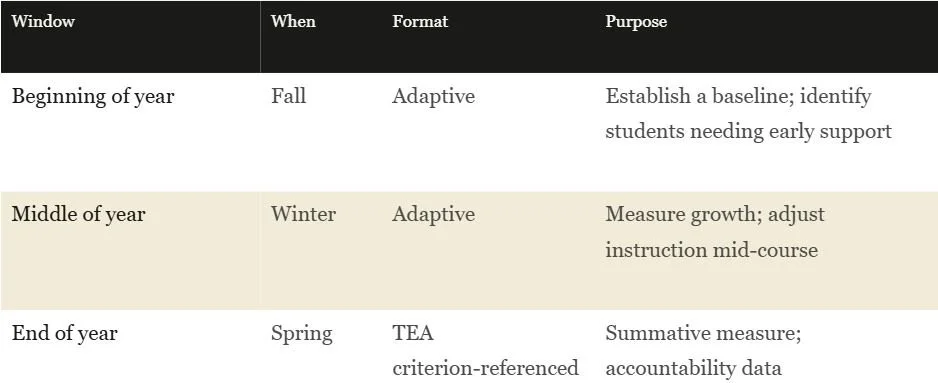
Districts may optionally use approved national norm-referenced tests in place of the BOY and MOY windows — at the district's own expense. The end-of-year exam will be developed by the Texas Education Agency itself and criterion-referenced to the TEKS, ensuring that what gets measured reflects what Texas classrooms are required to teach.
Important note for math departments:
STAAR continues through the 2026–27 school year. The Student Success Tool does not launch until 2027–28. Districts should use the two-year transition window to prepare staff, review data practices, and participate in the TEA field testing that will help shape the final instruments.
Why This Matters Specifically for Math
Math instruction in Texas has long operated under a shadow of late data. STAAR results typically returned in summer, long after the teacher-student relationship had ended and any intervention opportunity had passed. A student who struggled with fractions in October might not be formally identified until August — by which point they had lost an entire school year of potential support.
The through-year model directly addresses this lag. A fall baseline in math gives teachers actionable information within weeks of the school year starting. A winter check confirms whether interventions are working or whether a different approach is needed. The spring EOY exam then provides the summative accountability data that the system requires.
"The Legislature has heard the concerns of parents, teachers, and communities and delivered a smarter, student-centered assessment system in HB 8."
— Cary Wright, CEO, Good Reason Houston
There is also a structural benefit for math teachers specifically: the adaptive design of the BOY and MOY means that students working above grade level in mathematics will receive questions that challenge them, rather than sailing through a test that tells their teacher nothing useful. Conversely, students who are behind receive questions calibrated to reveal where in the learning progression the gap actually lives — not just that a gap exists.
The Path to HB 8
The road to this law was bumpy. During the regular 89th Legislative Session, House Bill 4 — a sweeping assessment reform bill — passed both chambers with broad bipartisan support but died in conference committee on May 31, 2025, with hours to spare. The House and Senate disagreed on a fundamental measurement question: should the new assessments be nationally norm-referenced, measuring Texas students against a national sample, or criterion-referenced against the TEKS?
June 2, 2025
The 89th Legislature's regular session ends without a deal on assessment reform. HB 4 dies in conference committee. STAAR continues for 2025–26.
August 15, 2025
Governor Abbott calls a second called special session, placing assessment reform on the agenda.
August 26–27, 2025
Both chambers pass HB 8 after extended debate. The compromise: TEA develops its own criterion-referenced EOY exam; districts may optionally use national tests for BOY and MOY.
September 17, 2025
Governor Abbott signs HB 8 into law. STAAR for grades 3–8 is phased out after 2026–27.
2027–28 school year
The Student Success Tool launches statewide. The new three-window system goes live for all grades 3–8 in math and reading.
HB 8 resolved the standoff by splitting the difference: the BOY and MOY windows can optionally use national norm-referenced tests at district expense, while the high-stakes EOY exam is a TEA-built, TEKS-aligned instrument. It is a compromise that reflects the political reality — and one that gives districts some flexibility in how they approach the early windows.
Accountability Changes
Beyond the testing windows themselves, HB 8 makes several changes to how schools are evaluated — with meaningful implications for math.
The law requires that a statewide annual student growth measure be incorporated into A–F accountability ratings by the 2029–30 school year. For math programs, this is significant: a growth model rewards campuses that are moving students forward even when those students haven't yet crossed a proficiency threshold. A school that brings struggling math students from far below grade level to approaching grade level would, under a growth model, receive credit for that work — something the binary STAAR proficiency model largely failed to capture.
HB 8 also directs the TEA to partner with a higher education institution to study additional accountability measures — including teacher quality, school climate, parent engagement, and workforce readiness — with findings due by December 1, 2028. The results of that study will inform future legislative sessions and could expand the indicators that define a "good school" in Texas beyond test scores alone.
01 - Three windows: BOY, MOY, and EOY assessments replace the single STAAR exam for grades 3–8 starting in 2027–28.
02 - Adaptive testing: BOY and MOY exams adjust to each student's level, giving teachers a more precise diagnostic picture.
03 - Growth measure: A statewide student growth measure must be added to A–F ratings by the 2029–30 school year.
04 - Teacher voice: A formal educator review process gives Texas teachers a role in shaping how new assessments are designed.
The Bigger Picture: HB 8 and HB 2 Together
HB 8 does not stand alone. The 89th Legislature also passed House Bill 2 — signed in June 2025 — which invested $648 million in early literacy and numeracy programs and required all K–8 math teachers, principals, assistant principals, math coaches, and interventionists to complete a Texas Mathematics Academy by the 2030–31 school year.
These two laws form a coherent pair. HB 2 invests in the quality and preparation of the adults teaching math. HB 8 changes the measurement system those adults use to track student progress. Together, they push in the same direction: away from a single high-stakes moment and toward a continuous cycle of instruction, assessment, and response.
"This is more than a testing shift — it is about how adults use data and decisions to impact student success and equity."
— DiscoveringU, community brief on HB 8
Skeptics are right to note that three tests per year is not necessarily less testing than one — and that testing time may be redistributed rather than reduced. The Association of Texas Professional Educators has raised legitimate questions about whether the new system's complexity could increase rather than decrease the burden on teachers. These concerns deserve honest engagement as implementation proceeds.
What Math Educators Should Do Now
The 2027–28 launch date may feel distant, but two years moves quickly in a school district. Here is what math teachers, coaches, and administrators should be doing in the transition window:
First, participate in field testing. HB 8 requires districts to participate in all field testing necessary to develop the new Student Success Tool. This is not optional, and it is also an opportunity — teachers who engage with the pilot instruments will have a head start on understanding how the new assessments are structured and what they demand of students.
Second, begin building data-response routines now. The through-year model only delivers value if teachers know what to do with assessment data when it arrives in October or January — not just in May. Professional learning communities, grade-level data meetings, and intervention protocols should be designed around the assumption that meaningful data will arrive early in the year.
Third, prioritize the Texas Mathematics Academies. HB 2's requirement that K–8 math teachers complete a Mathematics Academy is not merely a compliance checkbox. The academies are built around how students actually develop mathematical understanding — number sense, place value, operational reasoning — and the professional learning they offer directly supports the instructional responsiveness that HB 8's three-window model demands.
The bottom line: HB 8 is a genuine opportunity to make assessment serve instruction rather than replace it. Whether that opportunity is realized depends entirely on what happens in individual classrooms — and that starts with math teachers understanding not just what changed, but why.
Resources for districts:
The TEA's HB 8 FAQ document (tea.texas.gov) is updated regularly with implementation guidance. Districts should also review IMRA-approved supplemental math materials for the 2026–27 transition year and begin identifying which staff will need to complete the Texas Mathematics Academies before the 2030–31 deadline.

How to Carry the Wins From This Year Into Next Year
There is a particular habit that educators are exceptionally good at, and it is not one that serves them well. The moment a school year ends, most teachers and leaders do a rapid inventory of everything that went wrong. The unit that flopped. The student they could not quite reach. The initiative that never gained traction. The goal they set in August that quietly disappeared by October. The meeting that went sideways. The data that did not move the way everyone hoped it would.
The losses are loud. The wins have a way of going silent.
This is worth paying attention to, because the wins are not just feel-good moments to celebrate before moving on. They are data.
There is a particular habit that educators are exceptionally good at, and it is not one that serves them well. The moment a school year ends, most teachers and leaders do a rapid inventory of everything that went wrong. The unit that flopped. The student they could not quite reach. The initiative that never gained traction. The goal they set in August that quietly disappeared by October. The meeting that went sideways. The data that did not move the way everyone hoped it would.
The losses are loud. The wins have a way of going silent.
This is worth paying attention to, because the wins are not just feel-good moments to celebrate before moving on. They are data. They are evidence of what is possible. They are proof that you and your students and your colleagues are capable of more than the hardest days of the year would suggest. And if you do not intentionally carry them forward, you risk rebuilding from scratch something you already figured out.
Education has a short memory problem. Not because educators are careless, but because the pace of the work leaves very little room for institutional reflection. One year ends and another begins, and the lessons learned in the process get buried under the urgency of what comes next. The result is a profession that works incredibly hard and yet sometimes finds itself solving the same problems year after year, not because the people are not capable, but because the wins never got captured, shared, or built upon.
That cycle can be interrupted. It starts with a decision — made intentionally, before the last bell rings — to treat this year's wins as a resource worth protecting.
Here is how to do that.
Name the Wins Before You Forget Them
This sounds simple, and it is — but most educators skip it entirely. Before the year closes out, sit down and write out what actually worked. Not in vague terms, but specifically. Which lesson generated the most genuine engagement? Which conversation shifted something for a student or a teacher? Which decision, in hindsight, was exactly right? What did you try for the first time that you want to do again? Which relationship, built slowly and intentionally over the course of the year, produced something you did not expect?
Write it down. The details you are holding right now will not survive the summer. The clarity you have about your own practice in May and June is sharper than it will be at any other point in the year. You are close enough to the work to remember the specifics, and far enough from the beginning of the year to have real perspective on how things unfolded. That combination is rare. Do not let it pass without capturing something.
This does not have to be a formal process. It does not require a template or a committee or a professional development session. It requires fifteen or twenty minutes, something to write with, and the discipline to focus on what went right before the pull toward self-critique takes over. Some educators keep a running list throughout the year. Others do a single end-of-year reflection. The format matters far less than the act of doing it at all.
If you lead a team, build this into your final meetings of the year. Give people time — structured, protected time — to name their wins out loud. Not just the campus wins or the data wins, but the small human wins that rarely make it into any official report. The student who started the year refusing to write and ended it asking for more paper. The teacher who tried something terrifying and discovered they were better at it than they thought. The team that had a hard conversation they had been avoiding for two years and came out stronger on the other side.
Those things happened. They deserve to be named.
Understand Why Something Worked, Not Just That It Worked
A win without analysis is just a good memory. It feels meaningful in the moment, but without understanding what produced it, you cannot reliably reproduce it. And reproducibility is the whole point.
What made that lesson land? Was it the structure, the topic, the timing, the way students were grouped, the level of choice they were given, the way you framed the opening, the way you closed it? Was it something about the sequence — the fact that students had been building toward that moment for weeks and arrived at it ready? Was it the physical environment, the energy in the room, the fact that you had done something earlier that week that earned enough trust to take a risk?
What made that difficult conversation go well? Was it the relationship you had built beforehand? The timing — the fact that you waited for the right moment instead of forcing it? The way you opened without accusation or defensiveness? The fact that the other person felt genuinely heard before you asked anything of them?
What made that initiative actually gain traction this year when similar efforts had stalled before? Was it the way it was introduced? The level of teacher voice and input that shaped it? The fact that leadership modeled it instead of just mandating it? The way progress was acknowledged along the way?
These are not rhetorical questions. They are the most important professional development questions you can ask, and you are the only one who can answer them. When you understand the conditions that produced a win, you can recreate those conditions. When you only remember that something felt good, you are left hoping it happens again.
This kind of reflective analysis is also what separates educators who grow steadily over time from those who plateau. Growth is not just about trying new things. It is about understanding what you are already doing well and doing it more deliberately, more consistently, and in more contexts. The best teachers are not the ones who constantly reinvent themselves. They are the ones who understand their own craft deeply enough to know what to keep, what to refine, and what to let go.
Share Your Wins With Your Team
One of the greatest losses in education is the brilliant thing a teacher figured out in room 214 that no one in room 216 ever heard about. Wins that stay private stay small. The knowledge, creativity, and hard-won insight that lives inside individual classrooms is one of the most underutilized resources in any school building, and the end of the year is one of the best opportunities to change that.
Before the year ends, create space for your team to share what worked. Not in a performative way — not a celebration assembly with certificates and clapping — but in a genuine, practical, professional conversation that treats teacher knowledge as the valuable resource it actually is. What did you figure out this year that your colleagues could use? What would you want someone to tell you if they had already solved a problem you are still wrestling with?
Leaders, this is yours to facilitate. The culture of sharing does not happen organically in most schools because the conditions that would allow it — time, trust, and psychological safety — have to be built and protected deliberately. When you create a meeting structure that invites genuine reflection and sharing, when you model vulnerability by naming your own wins and what you learned from them, when you respond to teacher sharing with curiosity instead of evaluation, you are building something that will compound over time.
Ask your teams directly: What worked this year that we should build on? Then listen like the answer matters, because it does. Take notes. Follow up. Reference what people shared in future conversations. Nothing signals that something was worth saying more than evidence that it was actually heard.
Wins shared across a team also do something important for morale. They remind people that the work is working — that in the midst of all the challenge and complexity and exhaustion, real things are happening for real students. That reminder is not a luxury. At the end of a long school year, it is a necessity.
Build Your Wins Into Next Year's Plan From the Beginning
August planning tends to start with problems to solve. What were the gaps? What needs to improve? Where did we fall short, and what are we going to do differently? Those are important questions, and they deserve serious attention. But they are incomplete without the equally important question that almost never makes it onto the agenda: what do we want to make sure we do not lose?
When you sit down to plan for next year — whether that is a personal planning session, a team planning retreat, or a campus-wide professional development day — put your wins on the table alongside your challenges. Let them shape your priorities. Let them be the proof points that anchor your confidence when something new and hard feels uncertain. Let them be the starting line instead of the finish line.
This is especially important for leaders who are under pressure to constantly introduce new initiatives, new frameworks, and new approaches. The temptation in education is always to look outward for solutions — to the next book, the next conference, the next model from a high-performing district somewhere else. Sometimes that outward search is exactly right. But sometimes the answer is already inside your building, living in the practices of your best teachers and the decisions that moved your campus forward this year. Naming and building on those wins is not complacency. It is wisdom.
A practical way to do this is to create what some educators call a "keep, refine, release" framework as part of end-of-year planning. What are we keeping exactly as it is because it is working? What are we refining because it has promise but needs adjustment? What are we releasing because it is not producing results and is costing us energy we could spend elsewhere? This kind of structured reflection ensures that next year's plan is rooted in evidence rather than just optimism, and that wins are protected rather than accidentally abandoned in the rush toward improvement.
Let the Wins Travel With You Into Summer
Educators are not great at resting. The same drive and sense of responsibility that makes someone effective in a classroom or a campus can also make it very difficult to step away, be present in their own life, and allow the recovery that makes sustainable excellence possible.
But rest without reflection is just avoidance, and reflection without rest leads to burnout. The goal is both — and the wins are what make that balance possible.
When you carry your wins into summer, you are not carrying work. You are carrying evidence of your own effectiveness. You are carrying the knowledge that what you did this year mattered, that the hard days were not the whole story, and that the foundation you built is solid enough to build on. That is not a burden. That is fuel.
Give yourself permission to feel proud. Not in a way that closes you off to growth, but in a way that honors the reality of what you did. Teaching is one of the most complex, demanding, and consequential professions that exists. Leading a school requires a level of skill, emotional intelligence, and sustained commitment that very few professional environments demand. You did that for another full year. The wins from that year are not small. They deserve to be held.
Let the Wins Remind You of Who You Are as an Educator
The end of a school year can leave even the most dedicated educators feeling depleted. The work is heavy, the stakes are high, and the distance between the vision and the reality can feel discouraging on the hardest days. Standardized testing reduces complex human growth to numbers. Budget constraints limit what is possible. Students who needed more than the system could give them move on without the breakthrough everyone was hoping for. Leaders make decisions with imperfect information and live with the consequences. Teachers pour themselves into relationships that end every May and have to be rebuilt every August.
In those moments of depletion, the wins are not just professional data points. They are reminders of your capacity, your purpose, and your impact. They are the evidence — gathered across an entire school year, through hundreds of decisions and interactions and lessons and conversations — that you are doing something real. That the work you chose is the work you are meant to do. That the students and colleagues whose lives intersected with yours this year are better for it.
You did things this year that made a difference. Real things, for real students and real adults, in real moments that will not show up on any accountability report and will not be captured in any end-of-year summary. Those things happened because of who you are and the choices you made, and no amount of end-of-year exhaustion can take them away from you.
Carry them forward. Write them down. Share them with your team. Build them into your plans. Hold them close on the days next year when the work feels impossible and the progress feels invisible.
The next school year does not have to start from zero. It can start — and it should start — from everything you already know, everything you already proved, and everything you already are.
That is not a small thing. That is everything.

Backward Design in Practice: Starting With the End in Mind
Backward design does not ask you to work harder. It asks you to think differently — starting not with what you will teach, but with what students will be able to do when the teaching is done.
Consider this a practical guide to what backward design actually is, why it matters more now than ever, and how to use it — for real teachers and instructional leaders, not just curriculum theorists.
One question I ask in almost every curriculum workshop I lead is deceptively simple — what do educators do first when they sit down to plan a unit?
Most of the time, the answer is some version of: "I look at the standard, find some activities I like, and build from there."
I get it. That is how most of us were taught to plan. And honestly, it works — until it does not. Until you get to the end of the unit and realize students can do the activity but cannot explain the concept. Until the STAAR results come back and you know your kids worked hard but the data does not show it. Until you look back at six weeks of lessons and realize there was no coherent arc running through any of it.
That is not a teacher problem. That is a design problem. And backward design is the fix.
Backward design does not ask you to work harder. It asks you to think differently — starting not with what you will teach, but with what students will be able to do when the teaching is done.
Consider this a practical guide to what backward design actually is, why it matters more now than ever, and how to use it — for real teachers and instructional leaders, not just curriculum theorists.
What Backward Design Actually Means
Backward design comes from Grant Wiggins and Jay McTighe's framework, Understanding by Design (UbD), first published in 1998. The core idea is simple but transformative: you start with the end in mind.
Instead of asking "What will I teach?", backward design asks three questions in a specific order:
▸ What should students know, understand, and be able to do by the end of this unit?
▸ How will I know if they got there? What does mastery look like, and how will I measure it?
▸ What learning experiences will get them from where they are to where they need to be?
Notice what is different. In traditional planning, the activity comes first and the assessment comes last — almost as an afterthought. In backward design, the assessment comes second. You design the destination before you map the route.
This shift sounds small. It is not. When you know exactly what mastery looks like before you plan a single lesson, everything changes: the rigor of your instruction, the relevance of your activities, the coherence of your unit, and the validity of your assessment.
Why It Matters More Than Ever
Texas teachers are operating in a high-stakes environment. The STAAR redesign has placed greater emphasis on critical thinking, application, and multi-step reasoning — especially in math. Students are no longer rewarded just for knowing a procedure. They are expected to explain their thinking, apply concepts to novel situations, and demonstrate understanding in ways that go beyond recall.
That is exactly what backward design was built for.
When you start with the standard — really unpack it, understand what it is asking students to do at the highest level of rigor — and then design your assessment around that, you stop accidentally teaching to a lower level than the test demands. You stop spending three days on procedures when the standard calls for conceptual understanding. You stop writing assessments that test what is easy to grade instead of what actually matters.
If your assessment does not align to the rigor of the standard, it does not matter how good your lessons are. You are preparing students for a destination they are not actually headed to.
I have worked with campuses across Texas — including schools under Comprehensive Support and Improvement (CSI) designations fighting to improve accountability outcomes — and the most common pattern I see is this: teachers who work incredibly hard, plan thoughtful lessons, and genuinely care about their students, but whose assessments are not aligned to the cognitive demand of the standard. The teaching is good. The design is off.
Backward design closes that gap.
The Three Stages in Practice
Let us make this concrete. I am going to walk through all three stages of backward design using a secondary math example, but the same framework applies to any content area.
Stage 1: Identify desired results
This is where most planning should begin — and where most planning skips too quickly. Start with your standard, but do not stop there. Ask:
▸ What is the standard really asking students to do? Not the surface-level skill, but the deep understanding.
▸ What enduring understanding do I want students to carry with them long after this unit ends?
▸ What essential questions will drive inquiry throughout the unit?
▸ What misconceptions do students typically bring to this content, and how will I address them?
Let us use TEKS 8.8C as an example: modeling and solving one-variable equations with variables on both sides of the equal sign using rational number coefficients and constants. A surface-level read says: "teach students to move variables to one side and solve." That is fine as far as it goes. But the deeper understanding is this: an equation is a statement of balance — two expressions that are equal in value — and every step in the solving process is a move to maintain that balance while isolating the unknown variable. The procedure only makes sense when students understand what equality actually means.
If you plan your unit around that enduring understanding, your instruction will look completely different than if you plan it around "get the variable on one side." Same standard. Very different depth.
Stage 2: Determine acceptable evidence
Here is the stage that changes everything. Before you plan a single lesson, ask: what will I accept as evidence that a student has truly mastered this standard?
This means designing — or at minimum sketching — your summative assessment before you write your lesson plans. Not so you can teach to the test, but so you can teach toward the right level of rigor.
Think about:
▸ What does the highest-level question on this assessment look like? Does it match the cognitive demand of the standard?
▸ What does a student who truly understands this concept look like? What can they do that a student who only memorized a procedure cannot?
▸ How will I also assess throughout the unit — through formative checks, exit tickets, or observations — so I know where students are before we get to the end?
When I work with teachers on this stage, the most common aha moment is this: "I would never have put that question on a quiz." Exactly. Because we tend to write assessments that are easy to score, not assessments that reveal understanding. Stage 2 forces you to be honest about what you are actually measuring.
Stage 3: Plan learning experiences
Only now do you plan your lessons. And here is the beautiful thing: when you have done stages 1 and 2 well, stage 3 becomes clearer. You are not asking "What activities do I have?" You are asking "What does a student need to experience, practice, and grapple with in order to demonstrate the understanding I defined in stage 2?"
That question leads you to better lesson design naturally. It helps you sequence instruction more intentionally. It helps you decide what to cut when time is short. And it helps you explain to students why they are doing what they are doing — because you know.
When planning Stage 3, consider:
▸ What prior knowledge do students need, and how will I activate or fill gaps?
▸ What is the right balance of direct instruction, guided practice, and productive struggle?
▸ Where in the unit do I need to slow down and let misconceptions surface?
▸ How does each lesson connect to the enduring understanding I identified in Stage 1?
Common Mistakes (and How to Avoid Them)
I have supported a lot of teachers and instructional coaches through backward design, and I have seen the same stumbling blocks come up again and again.
Mistake 1: Treating the standard as the destination
The standard tells you what students need to be able to do. It does not tell you what understanding is underneath that skill. If you only plan to the standard at face value, you will often land at a lower level of rigor than the assessment demands. Dig one level deeper. Ask: what conceptual understanding makes this skill possible?
Mistake 2: Writing the assessment after the lessons
Old habits die hard. But if you write your lessons first and your assessment last, you will — every time — write an assessment that tests what you taught rather than what the standard demands. Reverse it. Even a rough draft of the summative assessment, written before lesson planning begins, will transform the alignment of your unit.
Mistake 3: Confusing activity with understanding
A student can complete an activity perfectly without understanding anything. If your Stage 3 is full of engaging activities but your Stage 1 and 2 are weak, you will have a fun unit with disappointing results. The activity is the vehicle. The understanding is the destination. Keep your eye on the destination.
Mistake 4: Doing this alone
Backward design is most powerful as a collaborative process. When a team unpacks a standard together, wrestles with what "mastery" really looks like, and co-creates an assessment before planning lessons, the conversations that happen are some of the richest professional learning a campus can produce. If you are an instructional leader, build this into your PLC structure. Do not let it be something teachers do in isolation.
What This Looks Like for Instructional Leaders
If you are a principal, instructional coach, or curriculum coordinator reading this, here is how you can use backward design as a leadership tool — not just a planning tool.
Start by looking at your campus's current unit plans or lesson guides. Ask one question: was the summative assessment designed before or after the lessons? If you do not know, that is your answer. Most units are built forward — lessons first, assessment last.
Your next step is not to mandate a new planning template. It is to create a conversation. Bring your team together around one upcoming unit and walk through all three stages together. What do we want students to understand? What will we accept as evidence? What do they need to experience to get there?
That conversation, done well, is better professional development than almost any workshop you could bring in. It builds shared understanding of rigor, alignment, and student expectations. It surfaces disagreements about what mastery looks like — which is exactly the kind of productive friction that makes teams stronger.
The goal is not a perfect template. The goal is a shared understanding of where you are going and what it looks like when you arrive.
From there, build the habit. Make Stage 1 and Stage 2 non-negotiable parts of unit planning. Use walkthroughs to look not just at what is being taught, but at how the lesson connects to the unit's enduring understanding. Use data conversations to ask not just "what does the data say?" but "did our assessment actually measure what we intended to teach?"
That last question is uncomfortable. It is also one of the most important questions an instructional leader can ask.
The Bottom Line
Backward design is not a new idea. It has been around for decades, and for good reason: it works. When teachers start with a clear picture of the destination, plan assessments that match the rigor of the standard, and build learning experiences that move students toward real understanding, the results follow.
But like any framework, it only works if it is actually used — not just referenced in a curriculum guide or mentioned in a PD session and then forgotten. It has to become the way your team thinks about planning. That takes time, practice, and the kind of instructional leadership that keeps the focus on what matters most.
If your campus is struggling with assessment alignment, unit coherence, or the gap between what is taught and what is tested, backward design is worth a serious investment of time and energy. Start with one unit. Do all three stages, in order, before a single lesson is written. See what shifts.
I would be willing to bet the conversations alone are worth it.

Designing Lessons That Promote Conceptual Understanding in Math
For decades, mathematics instruction in many classrooms has emphasized procedural fluency—teaching students the steps necessary to arrive at the correct answer. Students learned algorithms, memorized formulas, and practiced solving similar types of problems repeatedly. While these skills are certainly important, they represent only one dimension of mathematical proficiency. Students who only learn procedures often struggle when they encounter unfamiliar problems, need to explain their reasoning, or apply their knowledge in new contexts. Conceptual understanding addresses this gap
For decades, mathematics instruction in many classrooms has emphasized procedural fluency—teaching students the steps necessary to arrive at the correct answer. Students learned algorithms, memorized formulas, and practiced solving similar types of problems repeatedly. While these skills are certainly important, they represent only one dimension of mathematical proficiency. Students who only learn procedures often struggle when they encounter unfamiliar problems, need to explain their reasoning, or apply their knowledge in new contexts.
Conceptual understanding addresses this gap. When students develop conceptual understanding in mathematics, they grasp the underlying principles that explain why procedures work. They recognize relationships between ideas, understand how different representations of a concept connect, and can use their knowledge flexibly. Instead of viewing mathematics as a set of disconnected rules, they see it as a coherent system of ideas.
Designing lessons that promote conceptual understanding requires intentional planning. It involves choosing the right tasks, structuring meaningful discussions, using multiple representations, and building learning experiences that allow students to make sense of mathematics. When teachers thoughtfully design lessons with conceptual understanding as a goal, students develop deeper reasoning skills and greater confidence in their mathematical abilities.
Understanding the Difference Between Procedural and Conceptual Learning
Procedural fluency refers to the ability to carry out mathematical procedures accurately and efficiently. This includes performing operations, applying formulas, and following established steps to solve problems. Procedural knowledge is essential; students need to be able to compute accurately and use mathematical tools effectively.
However, procedural fluency without conceptual understanding can lead to fragile learning. Students may remember how to perform a procedure temporarily but forget it later or misuse it when the problem looks slightly different. For example, a student might memorize the steps for solving a two-step equation but struggle to explain why those steps work or how the equation relates to a real-world situation.
Conceptual understanding, on the other hand, focuses on the relationships and structures within mathematics. Students who understand concepts can explain their reasoning, connect ideas across topics, and apply their knowledge to unfamiliar problems. They recognize patterns, understand the meaning behind symbols, and see mathematics as a system of connected ideas.
Effective mathematics instruction balances these two elements. Conceptual understanding supports procedural fluency, and procedural fluency reinforces conceptual understanding. Lessons designed with this balance in mind help students develop both accuracy and insight.
Starting with Meaningful Mathematical Tasks
One of the most powerful ways to promote conceptual understanding is to begin lessons with meaningful mathematical tasks. Rather than immediately demonstrating a procedure, teachers can present students with a problem that invites exploration and reasoning.
A meaningful task is one that requires students to think deeply about mathematical relationships rather than simply apply a known formula. These tasks often allow multiple strategies and encourage students to explain their reasoning. When students engage with such problems, they begin to construct their own understanding of the underlying concepts.
For example, instead of introducing the formula for the area of a rectangle and asking students to apply it, a teacher might present students with a problem involving tiling a rectangular garden with square tiles. Students might draw diagrams, count squares, or organize their work into rows and columns. Through this exploration, they naturally discover the relationship between length, width, and area.
Beginning with exploration gives students an opportunity to grapple with the mathematics before formalizing the concept. This productive struggle helps students develop ownership of their learning and creates a stronger foundation for later procedural fluency.
The Role of the CRA Progression: Concrete, Representational, Abstract
A powerful instructional framework that supports conceptual understanding in mathematics is the Concrete–Representational–Abstract (CRA) progression. This approach guides students through three stages of learning, allowing them to build understanding gradually and connect physical experiences to symbolic mathematics.
The concrete stage involves hands-on learning using physical objects or manipulatives. These might include base-ten blocks, fraction tiles, algebra tiles, counters, or geometric models. At this stage, students physically model mathematical ideas, which helps them develop an intuitive sense of how numbers and operations work.
For example, when learning about addition with regrouping, students might use base-ten blocks to combine tens and ones. When the number of ones exceeds ten, they physically exchange ten ones for one ten. This tangible experience helps students understand what regrouping actually represents rather than simply memorizing a rule.
The representational stage bridges the gap between physical objects and abstract symbols. In this phase, students use drawings, diagrams, tables, or visual models to represent mathematical ideas. These representations might include number lines, bar models, area models, or graphs.
Continuing the regrouping example, students might draw tens and ones or represent numbers using place-value charts. These visual models reinforce the concept introduced with manipulatives while gradually moving students toward more symbolic thinking.
Finally, the abstract stage introduces mathematical symbols, equations, and algorithms. By this point, students have developed an understanding of the concept through concrete and visual experiences. As a result, the symbols now represent ideas that students already understand rather than arbitrary rules to memorize.
In practice, effective lessons often move fluidly among these stages rather than strictly progressing through them once. Teachers may return to concrete or visual models when introducing new concepts or addressing misconceptions. The CRA progression ensures that students build strong conceptual foundations before relying solely on symbolic mathematics.
Encouraging Mathematical Discourse
Mathematical discourse plays a central role in developing conceptual understanding. When students talk about mathematics, they clarify their thinking, consider different perspectives, and deepen their understanding of key ideas.
In classrooms that emphasize discourse, students are encouraged to explain their reasoning, justify their solutions, and respond to the ideas of others. Rather than simply stating answers, they describe how they arrived at their conclusions and why their strategies work.
Teachers facilitate these conversations by asking purposeful questions. Questions such as “How do you know?”, “Can you explain your thinking?”, and “Is there another way to approach this problem?” prompt students to reflect on their reasoning and consider alternative strategies.
Discourse also allows teachers to highlight important mathematical ideas that emerge from student work. When a student presents a strategy, the teacher can connect that strategy to broader mathematical principles or representations. Over time, these discussions help students see how individual ideas fit into a larger mathematical framework.
Creating a culture where students feel comfortable sharing their thinking is essential. Students must feel safe making mistakes and revising their ideas. When mistakes are treated as opportunities for learning, classrooms become spaces where reasoning and exploration are valued.
Using Multiple Representations
Mathematical ideas become clearer when students encounter them in multiple forms. Representations such as diagrams, tables, graphs, equations, and verbal explanations each highlight different aspects of a concept.
For example, when students study proportional relationships, they might examine tables that show pairs of values, graphs that display linear relationships, equations that represent the relationship algebraically, and real-world contexts that illustrate proportional reasoning. Each representation offers a different lens through which students can understand the concept.
Connecting these representations helps students see how mathematical ideas relate to one another. A graph can illustrate the same relationship shown in a table, while an equation provides a symbolic description of that relationship. When students learn to move between representations, they develop a more flexible and comprehensive understanding of mathematics.
Teachers can support this process by intentionally incorporating multiple representations into lesson design. Instead of presenting a single method or format, lessons can encourage students to model their thinking visually, numerically, and symbolically. Over time, students begin to recognize patterns across representations and develop a deeper conceptual framework.
Anticipating and Addressing Misconceptions
Every mathematical concept has common misconceptions. These misunderstandings often arise when students attempt to apply procedures without fully understanding the underlying ideas. If misconceptions are not addressed, they can persist and interfere with future learning.
Effective lesson design anticipates these misconceptions and creates opportunities for students to confront them. Teachers can analyze student work, review common errors, and plan questions that surface misunderstandings during instruction.
For example, when teaching fraction multiplication, some students mistakenly apply addition rules. A teacher might present a visual model showing how fractions represent parts of a whole and then connect that model to the multiplication process. By addressing the misconception directly, students develop a clearer understanding of the concept.
Misconceptions can also be explored through classroom discussion. When students explain their reasoning, teachers gain insight into their thinking and can guide the conversation toward deeper understanding. Rather than simply correcting errors, teachers can ask questions that prompt students to reconsider their assumptions and refine their reasoning.
Structuring Lessons Around Mathematical Sense-Making
Conceptual understanding grows when students are actively involved in making sense of mathematics. Lesson structures that emphasize exploration, discussion, and reflection help students engage with mathematical ideas more deeply.
Many effective mathematics lessons follow a structure that begins with exploration, moves into discussion, and concludes with synthesis. During the exploration phase, students work individually or in groups to solve a problem or investigate a concept. The teacher observes their strategies and gathers examples of student thinking.
During the discussion phase, selected students share their strategies with the class. The teacher sequences these presentations intentionally, highlighting different approaches and connecting them to key mathematical ideas.
Finally, during the synthesis phase, the teacher helps students consolidate their understanding. This may involve summarizing important concepts, connecting strategies to formal mathematical language, or linking the lesson to previous learning.
This structure allows students to actively construct knowledge while still benefiting from teacher guidance. It balances student exploration with clear instructional support.
Building Coherent Learning Progressions
Conceptual understanding develops over time as students encounter related ideas across multiple lessons and grade levels. A well-designed lesson connects to prior knowledge while preparing students for future learning.
For example, students’ early experiences with equal groups in elementary school lay the foundation for multiplication. Later, this understanding supports work with ratios, proportions, and algebraic reasoning. When lessons are designed with these progressions in mind, students can see how new ideas build on previous concepts.
Teachers can strengthen these connections by explicitly linking new content to prior learning. Before introducing a new concept, they might ask students to recall related ideas or solve problems that activate relevant knowledge. These connections help students integrate new information into their existing understanding.
Coherence also involves aligning lessons with broader curriculum goals. When instructional materials are carefully sequenced, students experience mathematics as an interconnected discipline rather than a collection of isolated topics.
The Role of Strategic Questioning
Questioning is one of the most powerful tools teachers have for promoting conceptual understanding. Well-crafted questions encourage students to analyze relationships, justify their reasoning, and extend their thinking.
Effective questions often focus on reasoning rather than answers. For example:
“Why does this strategy work?”
“How does this representation show the relationship?”
“What would happen if the numbers were different?”
“Can you connect this method to the one we used earlier?”
These types of questions prompt students to examine the structure of the mathematics they are using. They also encourage students to reflect on their thinking and articulate their ideas clearly.
Teachers can plan key questions in advance as part of lesson design. By anticipating moments where deeper thinking is needed, they can guide students toward meaningful insights without simply providing explanations.
Supporting Productive Struggle
Conceptual understanding often develops through productive struggle—the process of working through challenging problems and refining ideas over time. When students encounter difficulties, they are forced to analyze the problem more deeply and consider alternative approaches.
However, productive struggle must be carefully supported. If a task is too difficult or students lack necessary background knowledge, frustration can replace meaningful learning. Teachers play an important role in providing appropriate scaffolding while still allowing students to engage with the challenge.
Strategies such as providing hints, asking guiding questions, or encouraging collaboration can help students persevere through difficult tasks. The goal is not to remove the challenge but to ensure that students have the support they need to continue thinking productively.
When students successfully work through challenging problems, they develop confidence in their problem-solving abilities. This confidence encourages them to take intellectual risks and engage more deeply with mathematical ideas.
The Impact of Conceptual Understanding on Student Learning
Students who develop strong conceptual understanding approach mathematics differently. They are more likely to explore multiple strategies, justify their reasoning, and make connections across topics. Instead of relying solely on memorized procedures, they use their understanding of mathematical structures to guide their thinking.
This deeper understanding also supports long-term retention. When students understand the relationships behind a procedure, they are less likely to forget it and more likely to adapt it to new situations. Conceptual understanding provides a framework that allows students to reconstruct procedures even if they forget specific steps.
In addition, conceptual understanding prepares students for more advanced mathematics. Topics such as algebra, geometry, and calculus require students to analyze relationships, interpret representations, and reason abstractly. Students who have developed conceptual foundations are better equipped to engage with these challenges.
Designing lessons that promote conceptual understanding requires thoughtful planning and a commitment to meaningful mathematical learning. By beginning with rich tasks, encouraging discourse, incorporating multiple representations, and using frameworks such as the Concrete–Representational–Abstract progression, teachers create environments where students can explore and understand mathematics deeply.
Conceptual understanding does not replace procedural fluency—it strengthens it. When students know why mathematical procedures work, they are more capable, confident, and flexible in their problem-solving.
Ultimately, mathematics education should help students see mathematics as a connected system of ideas that explains patterns, relationships, and structures in the world around them. Lessons designed with conceptual understanding at their core move classrooms closer to this vision, empowering students to engage with mathematics not just as a subject to learn, but as a powerful way of thinking.

Instructional Coaching Is Still the Most Powerful Form of Professional Development
Professional development (PD) in education has evolved dramatically over the past few decades. From traditional workshops and one-day conferences to online modules, webinars, and micro-credentials, teachers today have more options than ever to engage in professional growth. Despite these changes, one approach continues to stand out for its effectiveness and impact: instructional coaching. While modern technology and innovative PD methods can offer convenience and access to resources, they cannot replace the deep, personalized, and contextualized support that instructional coaching provides.
Professional development (PD) in education has evolved dramatically over the past few decades. From traditional workshops and one-day conferences to online modules, webinars, and micro-credentials, teachers today have more options than ever to engage in professional growth. Despite these changes, one approach continues to stand out for its effectiveness and impact: instructional coaching. While modern technology and innovative PD methods can offer convenience and access to resources, they cannot replace the deep, personalized, and contextualized support that instructional coaching provides. Instructional coaching remains the most powerful form of PD because it is relational, job-embedded, sustained over time, and directly connected to student outcomes.
Traditional professional development has long relied on the one-size-fits-all model: an expert delivers content to a large group of teachers, often outside of the classroom, and participants leave with handouts, ideas, and inspiration. While these sessions may provide valuable information and spark initial enthusiasm, research consistently shows that stand-alone workshops rarely lead to lasting changes in instructional practice. Teachers may feel motivated for a short time, but when they return to the realities of their classrooms, new strategies often fade without reinforcement, support, or practical application. The disconnect between PD and classroom practice is a fundamental challenge. Instructional coaching, on the other hand, addresses this gap by embedding support directly into the teacher’s daily work. Coaches observe lessons, model strategies, co-plan instruction, and provide feedback that is immediately relevant. This hands-on, contextualized support ensures that teachers can apply what they learn to their specific students, classroom dynamics, and curriculum requirements.
One of the most powerful aspects of instructional coaching is that it respects and honors teacher expertise. Coaching is not about fixing teachers or prescribing a rigid set of instructional practices. Effective coaches approach their work as partners with teachers, collaborating to identify areas for growth, set meaningful goals, and reflect on student outcomes. This relational approach fosters trust and encourages teachers to take risks in their practice. When teachers feel supported rather than judged, they are more willing to experiment with new strategies, engage in self-reflection, and embrace professional growth. The emphasis on partnership and reflection distinguishes coaching from other forms of PD that often rely on compliance or passive learning.
Another critical feature of instructional coaching is its sustained nature. Research on professional development repeatedly demonstrates that PD is most effective when it is ongoing rather than episodic. Single workshops or short-term interventions may introduce a new concept, but without continuous follow-up, teachers rarely internalize the learning or translate it into consistent classroom practice. Instructional coaching provides continuous support through cycles of observation, feedback, reflection, and refinement. This iterative process allows teachers to gradually develop expertise, build confidence, and make incremental adjustments to their teaching. Over time, these sustained interactions lead to significant changes in instructional practice, stronger student engagement, and improved academic outcomes.
Instructional coaching also strengthens school systems as a whole, not just individual teachers. While coaching is often framed as individual support, its impact is far-reaching. When implemented thoughtfully, coaching programs help schools align instructional practices with curriculum standards, assessments, and broader educational goals. Coaches can serve as bridges between district initiatives and classroom practice, helping teachers translate mandates into effective teaching strategies. Additionally, coaching fosters a culture of collaboration and continuous improvement. Teachers who engage in coaching often share insights and strategies with colleagues, creating a ripple effect that benefits the entire school community. By building collective efficacy, coaching contributes to sustained improvements in student learning and school performance.
One of the most significant advantages of instructional coaching is its adaptability. Today’s classrooms are increasingly complex, with diverse student populations, evolving standards, high-stakes assessments, and rapid technological changes. Teachers face the challenge of differentiating instruction, integrating technology effectively, supporting social-emotional learning, and meeting the needs of all students simultaneously. Instructional coaching is uniquely positioned to address these challenges because it is flexible and responsive. Coaches can tailor their support to the specific needs of teachers, whether that involves modeling effective use of instructional materials, integrating technology into lessons, analyzing student work, or implementing strategies for classroom management. This adaptability ensures that coaching remains relevant and impactful, even as educational landscapes change.
The research on instructional coaching underscores its effectiveness. Studies consistently show that teachers who participate in coaching demonstrate higher levels of instructional fidelity, increased student engagement, and improved learning outcomes. For example, a study conducted by Joyce and Showers (2002) found that teachers who received coaching were significantly more likely to implement new teaching strategies successfully compared to those who only attended workshops. Similarly, a report from the Institute of Education Sciences (IES) highlighted that coaching leads to measurable gains in student achievement, particularly in literacy and mathematics. These findings reinforce the idea that coaching is not merely a supportive gesture; it is a research-based approach that drives tangible results in classrooms.
Instructional coaching is also instrumental in supporting equity in education. Every classroom is different, and students come with varied backgrounds, abilities, and needs. Coaches work alongside teachers to ensure that instructional practices are responsive and inclusive. By analyzing student data, observing classroom interactions, and co-planning differentiated instruction, coaches help teachers meet the diverse needs of their learners. This personalized support is particularly important in schools serving historically marginalized communities or students with varying academic readiness levels. When teachers are equipped with the skills, strategies, and confidence to meet all students where they are, equity and access to high-quality instruction increase.
In addition to academic support, coaching fosters teacher well-being and professional satisfaction. Teaching can be isolating, and educators often face high levels of stress, burnout, and pressure to meet performance targets. Instructional coaching provides a professional partner who listens, reflects, and offers actionable guidance. This relational support helps teachers feel valued, empowered, and capable, which can reduce burnout and improve retention. Teachers who experience positive coaching relationships report higher job satisfaction, stronger engagement, and a greater sense of professional growth. By investing in coaching, schools not only improve instruction but also nurture the well-being of their educators.
Instructional coaching also bridges the gap between theory and practice. While PD modules, webinars, and readings provide valuable theoretical knowledge, teachers often struggle to apply this knowledge in dynamic classroom environments. Coaching provides the bridge by translating theory into actionable strategies. Coaches demonstrate instructional techniques in real time, offer feedback on implementation, and help teachers adjust approaches based on student responses. This practical application is essential for meaningful professional growth, as teachers learn not just what to do but how and when to do it effectively.
Moreover, instructional coaching is aligned with modern priorities in education, such as high-quality instructional materials (HQIM), evidence-based practices, and standards-aligned instruction. In districts implementing new curricula, coaching helps ensure that teachers understand the materials, adopt best practices, and maintain instructional fidelity. Rather than leaving teachers to navigate complex curriculum independently, coaches provide scaffolding, modeling, and ongoing support. This approach results in more consistent instruction across classrooms and ensures that students benefit fully from the intended design of the curriculum.
While technology and self-directed learning offer many benefits, they cannot replicate the relational, personalized, and adaptive nature of instructional coaching. Tools such as online modules or micro-credentials can provide knowledge, but they lack the embedded support that helps teachers apply learning effectively. Coaching complements these tools by providing context, feedback, and accountability. In essence, coaching makes all other forms of PD more powerful by ensuring that what teachers learn is implemented thoughtfully and effectively in the classroom.
Finally, instructional coaching builds capacity for long-term growth. Beyond immediate support, coaching develops teacher leaders, instructional leaders, and collaborative school cultures. Teachers who experience coaching often take on mentoring roles, lead professional learning communities, and contribute to a culture of reflective practice. This capacity-building effect ensures that schools can sustain improvement efforts and continue to grow even after formal coaching cycles conclude.
Instructional coaching is not a relic of traditional professional development—it is the most powerful form of PD precisely because it addresses the limitations of other approaches. It is relational, job-embedded, sustained, adaptive, and aligned to the realities of today’s classrooms. Coaching respects teacher expertise while fostering growth, strengthens school systems while improving individual practice, and translates theory into actionable strategies that benefit students immediately. While education continues to evolve with new technologies and innovative PD models, the evidence is clear: instructional coaching remains essential. Teachers grow best when they are supported, partnered with, and guided in context, and students thrive when instruction is informed, reflective, and responsive. As schools seek meaningful ways to improve teaching and learning, investing in instructional coaching is not just a strategy—it is a commitment to lasting, impactful change.

Creating Coherent Systems that Support Teaching and Learning
Education is an intricate ecosystem where countless moving parts—teachers, students, curriculum, assessments, and policies—interact every day. Yet too often, schools operate in fragmented ways: different departments pursue initiatives in isolation, teachers navigate inconsistent expectations, and students experience disjointed learning journeys. The solution lies in creating coherent systems—purposeful, aligned structures that consistently support teaching and learning.
Education is an intricate ecosystem where countless moving parts—teachers, students, curriculum, assessments, and policies interact every day. Yet too often, schools operate in fragmented ways: different departments pursue initiatives in isolation, teachers navigate inconsistent expectations, and students experience disjointed learning journeys. The solution lies in creating coherent systems—purposeful, aligned structures that consistently support teaching and learning. Coherence ensures that all actions and resources in a school serve a shared vision of student growth, making learning experiences more connected and meaningful.
At its core, coherence is about alignment and connection. In a coherent system, curriculum, instruction, and assessment work together so that what students are taught matches what they are expected to learn. Professional learning aligns with instructional priorities, ensuring teachers receive support that is relevant, timely, and actionable. Decision-making processes reinforce, rather than fragment, priorities so educators aren’t pulled in conflicting directions. Importantly, coherence does not mean rigid standardization. Teachers can still exercise creativity and adapt to their students’ needs, but their efforts remain aligned with the school’s broader goals.
The impact of coherent systems is profound. Research consistently shows that schools with aligned curriculum, instruction, and professional support achieve higher student outcomes and greater teacher satisfaction. Coherence reduces wasted time, prevents “initiative fatigue,” and helps educators see how their work fits into the bigger picture. By turning a school from a collection of individuals into a unified learning community, coherence fosters a culture of continuous improvement and shared responsibility.
Creating coherence requires intentional design. One critical component is aligned curriculum and instruction. Schools must have a well-structured curriculum that outlines learning objectives, scope and sequence, and recommended instructional strategies. Instruction should reinforce the curriculum goals through research-based practices, and materials should be regularly reviewed to ensure they remain rigorous and relevant. Integrated assessment systems are also essential. Assessments should inform instruction rather than simply measure it, combining formative, interim, and summative tools that align with the learning objectives. Teachers need timely, actionable data so they can adapt instruction and support students effectively.
Purposeful professional learning is another cornerstone of coherence. Professional development often fails when it is disconnected from classroom practice. Coherent systems embed teacher learning into meaningful contexts, offering ongoing coaching, feedback, and collaborative opportunities. Professional learning should connect directly to curriculum and assessment priorities, allowing teachers to apply new strategies immediately. Clear roles and responsibilities further support alignment. Leaders must communicate expectations and support structures, teachers must understand how their work contributes to school-wide goals, and support staff—such as instructional coaches or interventionists—should operate within the same framework to provide consistent support.
Coherent systems also require consistent monitoring and feedback loops. Alignment is not a one-time effort but a continuous process. Schools should regularly monitor student learning outcomes and instructional fidelity, use feedback loops to adjust curriculum and teaching strategies, and celebrate successes while addressing areas for improvement. Building coherent systems can feel overwhelming, but concrete steps make it manageable. Start with a shared vision of high-quality teaching and learning, map the existing initiatives and resources, align policies and practices to the vision, prioritize professional learning, create structures for collaboration, and continually monitor and refine the system.
While building coherence is challenging—resistance to change, overlapping initiatives, and limited resources can all slow progress—these challenges also provide opportunities for thoughtful planning and engagement. Transparent communication, incremental implementation, and a focus on shared goals can transform potential obstacles into levers for meaningful improvement. Ultimately, coherent systems are the backbone of effective teaching and learning. They create alignment, reduce inefficiency, foster a culture of continuous growth, and support both teachers and students. When schools invest in coherence, they do more than improve instruction—they create an ecosystem where learning thrives, teaching is elevated, and every member of the school community understands their role in advancing student success.

Building Confidence with EdTech: Tips for Teachers New to Digital Integration
Technology is transforming classrooms at every level. From interactive whiteboards and learning management systems to virtual simulations and educational apps, EdTech offers countless opportunities to engage students, differentiate instruction, and streamline teaching. But for many educators, integrating technology can feel overwhelming. Where do you start? How do you know which tools will make a difference?
Technology is transforming classrooms at every level. From interactive whiteboards and learning management systems to virtual simulations and educational apps, EdTech offers countless opportunities to engage students, differentiate instruction, and streamline teaching. But for many educators, integrating technology can feel overwhelming. Where do you start? How do you know which tools will make a difference? And what if something goes wrong in the middle of a lesson?
Building confidence with EdTech doesn’t happen overnight, but it is achievable with intentional steps. This guide provides practical strategies to help teachers feel empowered, reduce stress, and successfully integrate digital tools into their classrooms — regardless of prior experience.
I - Understanding the Role of EdTech in Modern Classrooms: EdTech is not about replacing teachers; it’s about enhancing teaching. When used thoughtfully, technology can:
Support differentiated instruction for diverse learners.
Provide immediate feedback through formative assessments.
Encourage student collaboration and engagement.
Give teachers more time for meaningful instructional planning.
For example, a simple tool like Google Forms or Plickers allows teachers to check understanding instantly. Instead of manually grading quizzes, teachers receive real-time data about what students understand and where they struggle. Similarly, interactive tools like Padlet, Miro, or Whiteboard.fi encourage students to brainstorm collaboratively, giving quieter students a voice.
By understanding the purpose behind each tool, teachers can integrate technology without feeling like it’s a distraction or a burden. The goal is always to enhance learning — not to add extra steps or complexity.
II - Start Small: Building Skills Gradually: The most common mistake new EdTech users make is trying to do too much at once. Introducing multiple tools in a single week can be overwhelming and counterproductive. Instead, start small and grow gradually.
Here’s a simple roadmap:
Pick One Tool at a Time: Start with a platform that solves a specific classroom need. For example:
Kahoot or Quizizz for fun, low-stakes formative assessment.
Google Slides or Nearpod for interactive lessons.
Set Manageable Goals: Focus on mastering one feature at a time rather than trying to use the entire platform.
Document Your Progress: Keep a small journal of successes, lessons learned, and reflections.
For instance, a teacher might begin by using Google Forms for exit tickets. Once comfortable, they can add conditional logic or use the data to group students for targeted support. Gradual integration allows teachers to gain confidence while minimizing frustration.
III - Align Technology with Learning Goals: Technology should never drive instruction; instruction should drive technology use. Before using a tool, ask:
What is the learning outcome?
How does this tool help students understand content more deeply?
Is this appropriate for my students’ needs and abilities?
Consider these examples:
Purposeful Use: Using Padlet for students to brainstorm ideas encourages collaboration and critical thinking aligned with lesson objectives.
Less Effective Use: Playing a digital game that is engaging but unrelated to the lesson’s goal may entertain students without improving learning outcomes.
By keeping learning goals at the center, teachers can ensure that technology integration is meaningful, purposeful, and confidence-building.
IV - Embrace Learning Alongside Students: It’s normal to feel unsure when trying a new tool. One of the most effective ways to build confidence is to learn alongside students. Doing so models curiosity, problem-solving, and a growth mindset.
For example:
Introduce a new platform with students by exploring features together.
Encourage students to help troubleshoot or suggest tips they discover.
Celebrate learning moments when both teacher and students figure something out collaboratively.
This approach not only reduces pressure on the teacher but also encourages students to take ownership of their learning. Students often enjoy being the “tech expert,” and teachers gain confidence by seeing that mistakes are part of the learning process.
V - Professional Learning and Peer Support: No teacher should have to navigate EdTech alone. Professional development and peer collaboration are essential to building confidence.
Strategies include:
Workshops and Webinars: Participate in sessions focused on the tools you want to use. Many offer step-by-step demonstrations and practical classroom examples.
Peer Mentorship: Pair with colleagues who are more experienced. Observe their lessons, share resources, and exchange ideas.
Online Communities: Join forums, social media groups, or EdTech networks to ask questions, share successes, and troubleshoot challenges.
Even a 15-minute check-in with a colleague can provide insights, encouragement, and practical tips that accelerate learning. When teachers feel supported, they are more willing to experiment and take risks with new tools.
VI - Reflection and Iteration: Confidence grows when teachers take time to reflect on their practice and adjust as needed. After trying a new tool or strategy, consider:
What worked well?
What challenges arose?
How can I adjust next time to make it more effective?
A simple reflection journal or digital note-taking system can help track progress. Over time, teachers can see tangible growth, which builds confidence and provides a roadmap for continuous improvement.
VII - Overcoming Common Challenges: New EdTech users often face fears and obstacles. Some common challenges include:
Technical Glitches: Prepare a backup plan. If an activity fails, have a paper-based alternative ready.
Student Engagement: Introduce one new tool at a time and scaffold instructions. Avoid overwhelming students with too many platforms simultaneously.
Time Constraints: Allocate small blocks of time for practice, both for you and your students. Focus on learning outcomes rather than perfect execution.
Approaching challenges with a problem-solving mindset turns potential frustrations into learning opportunities for both teachers and students.
VIII - Building a Classroom Culture That Supports EdTech: A confident teacher is supported by a classroom culture that encourages experimentation and growth. Strategies include:
Encourage Exploration: Allow students to experiment with features of a new platform.
Foster Collaboration: Pair students for problem-solving, create student tech leaders, or rotate responsibilities for managing digital tools.
Celebrate Effort: Acknowledge successes, no matter how small, and highlight moments of perseverance.
When students feel safe to explore and take risks, teachers feel more confident trying new tools. The classroom becomes a space for shared learning, and technology integration feels natural rather than intimidating.
Conclusion: The Journey to Confidence
Building confidence with EdTech is a process, not an instant transformation. By starting small, aligning technology with learning goals, learning alongside students, leveraging professional learning, reflecting, and fostering a supportive classroom culture, teachers can develop the skills and confidence needed to integrate technology effectively.
Remember: every small success matters. Over time, these small steps add up to meaningful, impactful classroom integration. With persistence, reflection, and support, teachers can feel empowered to use technology to enhance learning, engage students, and streamline instruction — all while growing their own skills and confidence.
The journey may feel challenging at first, but the results — for both teachers and students — are transformative. With the right mindset and strategies, every educator can become confident in their ability to integrate EdTech successfully.
Thank you for reading! Subscribe to our newsletter for more helpful info and insights!

From Adoption to Implementation
Despite their benefits, some educators worry that HQIM might limit creativity or feel overly “scripted.” In reality, the opposite is true: when implemented thoughtfully and with fidelity, HQIM empowers teachers, enhances student learning, and allows educators to bring their own expertise and creativity into every lesson.
Ensuring Curriculum Fidelity Without Losing Flexibility
In education, acronyms are everywhere, but one that has gained particular prominence in recent years is HQIM—High-Quality Instructional Materials. These materials provide clear, standards-aligned guidance designed to support consistent and effective instruction across classrooms. Despite their benefits, some educators worry that HQIM might limit creativity or feel overly “scripted.” In reality, the opposite is true: when implemented thoughtfully and with fidelity, HQIM empowers teachers, enhances student learning, and allows educators to bring their own expertise and creativity into every lesson.
One of the largest investments a district can make is in curriculum and instructional resources. Naturally, the question arises: “How do we stay true to a curriculum’s intent without stifling teacher autonomy?” There is a common misconception that HQIM are restrictive, but the key is fidelity—implementing the materials as designed while still allowing teachers to exercise professional judgment and creativity. Fidelity does not mean a rigid script; rather, it preserves the progression, instructional routines, and research-backed design that make the curriculum effective, creating space for responsive teaching and meaningful student engagement.
Once a district adopts a curriculum, the real work begins. Successful implementation requires a well-thought-out rollout plan that includes comprehensive training, ongoing support, and sustained coaching. Internalizing a new curriculum can feel overwhelming, especially as today’s HQIM are more rigorous and comprehensive than ever before. When districts lack experienced personnel to lead implementation—or face budget constraints limiting access to external support—the burden often falls heavily on teachers. Yet with the right strategies, adopted HQIM can work for educators rather than against them. Teachers often have more ownership in the process than they realize.
The first and most important strategy is to trust the process. Change can be uncomfortable, and growing pains are inevitable. Embracing the learning journey, leaning into collaboration, and giving oneself the time and grace to build confidence are essential steps in mastering a new curriculum. Teachers often express concern that fidelity feels limiting. However, fidelity is not about control; it is about maintaining the integrity of the curriculum’s design while creating the space for responsive, purposeful teaching. When teachers understand the why behind lessons, fidelity becomes a framework for effective instruction rather than a constraint.
Shifting the culture around curriculum use begins with leadership. Moving from a mindset of “checklist compliance” to one of collective professional learning empowers teachers to implement HQIM with intention. Leaders can facilitate this shift by promoting collaborative planning sessions, helping teams unpack lessons to distinguish non-negotiables from adaptable elements, and coaching teachers on the rationale behind lesson structures. Providing opportunities for reflection and professional judgment further allows educators to exercise autonomy while honoring the curriculum’s intent.
A clear framework helps teachers balance fidelity with flexibility. Begin with faithful implementation, teaching lessons as designed to internalize their structure and intent. Once familiar with the curriculum, teachers can move to informed adaptation, making thoughtful adjustments that preserve core learning goals. Finally, innovation can emerge once mastery is achieved, allowing for creative modifications that enhance learning. True flexibility stems from understanding, not improvisation, and ensures that instructional adaptations maintain coherence and rigor.
Leaders play a pivotal role in sustaining effective implementation. Ongoing coaching, modeling of best practices, and protected planning time help teachers feel supported rather than constrained. Data conversations should focus on student learning and growth rather than compliance metrics. As one guiding principle notes, “Curriculum fidelity isn’t about control—it’s about coherence.” When leaders establish these conditions, they cultivate a culture where teachers can confidently balance fidelity with purposeful flexibility.
Adopting HQIM is a significant commitment to student success, but the true transformation occurs through thoughtful implementation. Fidelity and flexibility are not opposites; they are partners in effective teaching. When educators understand the intent behind the materials and are empowered to make informed decisions, fidelity becomes freedom—enabling teachers to deliver rigorous, engaging, and responsive instruction every day.