HB 8 and What It Means for Math Instruction in Texas
After years of frustration — from teachers spending weeks on test prep, to students receiving results too late to matter, to communities questioning whether one high-stakes spring exam could ever capture what a school does well — Texas finally acted. House Bill 8, passed during the 89th Legislature's second called special session and signed into law by Governor Greg Abbott on September 17, 2025, replaces the STAAR exam for grades 3–8 with a new three-window assessment system called the Student Success Tool.
For math educators, the implications run deeper than a name change. The law reshapes when students are assessed, how quickly results reach classrooms, and what teachers are expected to do with that data. Combined with the Math Academies and teacher certification reforms passed earlier in 2025 under HB 2, HB 8 represents the most comprehensive overhaul of math education policy in Texas in a generation.
What the Law Actually Does
The core shift is from one summative exam at the end of the year to three assessments — a beginning-of-year (BOY) test in the fall, a middle-of-year (MOY) check in winter, and an end-of-year (EOY) assessment in the spring — for students in grades 3 through 8 in reading, math, science, and social studies.
The BOY and MOY assessments will be adaptive, adjusting in difficulty based on how a student responds. That's a meaningful change for math: rather than every third grader answering identical questions regardless of their readiness, the test meets students where they are and produces a more precise picture of their learning progression. Results from these windows are intended to reach teachers quickly — a sharp contrast to STAAR scores, which historically arrived in summer after students had already left the building.
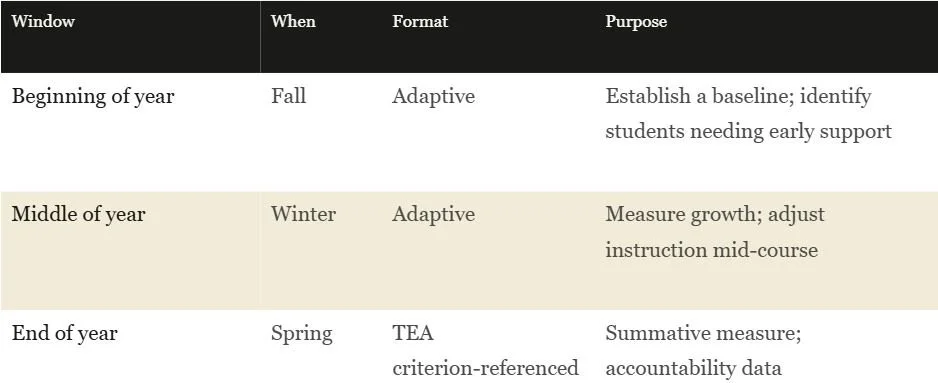
Districts may optionally use approved national norm-referenced tests in place of the BOY and MOY windows — at the district's own expense. The end-of-year exam will be developed by the Texas Education Agency itself and criterion-referenced to the TEKS, ensuring that what gets measured reflects what Texas classrooms are required to teach.
Important note for math departments:
STAAR continues through the 2026–27 school year. The Student Success Tool does not launch until 2027–28. Districts should use the two-year transition window to prepare staff, review data practices, and participate in the TEA field testing that will help shape the final instruments.
Why This Matters Specifically for Math
Math instruction in Texas has long operated under a shadow of late data. STAAR results typically returned in summer, long after the teacher-student relationship had ended and any intervention opportunity had passed. A student who struggled with fractions in October might not be formally identified until August — by which point they had lost an entire school year of potential support.
The through-year model directly addresses this lag. A fall baseline in math gives teachers actionable information within weeks of the school year starting. A winter check confirms whether interventions are working or whether a different approach is needed. The spring EOY exam then provides the summative accountability data that the system requires.
"The Legislature has heard the concerns of parents, teachers, and communities and delivered a smarter, student-centered assessment system in HB 8."
— Cary Wright, CEO, Good Reason Houston
There is also a structural benefit for math teachers specifically: the adaptive design of the BOY and MOY means that students working above grade level in mathematics will receive questions that challenge them, rather than sailing through a test that tells their teacher nothing useful. Conversely, students who are behind receive questions calibrated to reveal where in the learning progression the gap actually lives — not just that a gap exists.
The Path to HB 8
The road to this law was bumpy. During the regular 89th Legislative Session, House Bill 4 — a sweeping assessment reform bill — passed both chambers with broad bipartisan support but died in conference committee on May 31, 2025, with hours to spare. The House and Senate disagreed on a fundamental measurement question: should the new assessments be nationally norm-referenced, measuring Texas students against a national sample, or criterion-referenced against the TEKS?
June 2, 2025
The 89th Legislature's regular session ends without a deal on assessment reform. HB 4 dies in conference committee. STAAR continues for 2025–26.
August 15, 2025
Governor Abbott calls a second called special session, placing assessment reform on the agenda.
August 26–27, 2025
Both chambers pass HB 8 after extended debate. The compromise: TEA develops its own criterion-referenced EOY exam; districts may optionally use national tests for BOY and MOY.
September 17, 2025
Governor Abbott signs HB 8 into law. STAAR for grades 3–8 is phased out after 2026–27.
2027–28 school year
The Student Success Tool launches statewide. The new three-window system goes live for all grades 3–8 in math and reading.
HB 8 resolved the standoff by splitting the difference: the BOY and MOY windows can optionally use national norm-referenced tests at district expense, while the high-stakes EOY exam is a TEA-built, TEKS-aligned instrument. It is a compromise that reflects the political reality — and one that gives districts some flexibility in how they approach the early windows.
Accountability Changes
Beyond the testing windows themselves, HB 8 makes several changes to how schools are evaluated — with meaningful implications for math.
The law requires that a statewide annual student growth measure be incorporated into A–F accountability ratings by the 2029–30 school year. For math programs, this is significant: a growth model rewards campuses that are moving students forward even when those students haven't yet crossed a proficiency threshold. A school that brings struggling math students from far below grade level to approaching grade level would, under a growth model, receive credit for that work — something the binary STAAR proficiency model largely failed to capture.
HB 8 also directs the TEA to partner with a higher education institution to study additional accountability measures — including teacher quality, school climate, parent engagement, and workforce readiness — with findings due by December 1, 2028. The results of that study will inform future legislative sessions and could expand the indicators that define a "good school" in Texas beyond test scores alone.
01 - Three windows: BOY, MOY, and EOY assessments replace the single STAAR exam for grades 3–8 starting in 2027–28.
02 - Adaptive testing: BOY and MOY exams adjust to each student's level, giving teachers a more precise diagnostic picture.
03 - Growth measure: A statewide student growth measure must be added to A–F ratings by the 2029–30 school year.
04 - Teacher voice: A formal educator review process gives Texas teachers a role in shaping how new assessments are designed.
The Bigger Picture: HB 8 and HB 2 Together
HB 8 does not stand alone. The 89th Legislature also passed House Bill 2 — signed in June 2025 — which invested $648 million in early literacy and numeracy programs and required all K–8 math teachers, principals, assistant principals, math coaches, and interventionists to complete a Texas Mathematics Academy by the 2030–31 school year.
These two laws form a coherent pair. HB 2 invests in the quality and preparation of the adults teaching math. HB 8 changes the measurement system those adults use to track student progress. Together, they push in the same direction: away from a single high-stakes moment and toward a continuous cycle of instruction, assessment, and response.
"This is more than a testing shift — it is about how adults use data and decisions to impact student success and equity."
— DiscoveringU, community brief on HB 8
Skeptics are right to note that three tests per year is not necessarily less testing than one — and that testing time may be redistributed rather than reduced. The Association of Texas Professional Educators has raised legitimate questions about whether the new system's complexity could increase rather than decrease the burden on teachers. These concerns deserve honest engagement as implementation proceeds.
What Math Educators Should Do Now
The 2027–28 launch date may feel distant, but two years moves quickly in a school district. Here is what math teachers, coaches, and administrators should be doing in the transition window:
First, participate in field testing. HB 8 requires districts to participate in all field testing necessary to develop the new Student Success Tool. This is not optional, and it is also an opportunity — teachers who engage with the pilot instruments will have a head start on understanding how the new assessments are structured and what they demand of students.
Second, begin building data-response routines now. The through-year model only delivers value if teachers know what to do with assessment data when it arrives in October or January — not just in May. Professional learning communities, grade-level data meetings, and intervention protocols should be designed around the assumption that meaningful data will arrive early in the year.
Third, prioritize the Texas Mathematics Academies. HB 2's requirement that K–8 math teachers complete a Mathematics Academy is not merely a compliance checkbox. The academies are built around how students actually develop mathematical understanding — number sense, place value, operational reasoning — and the professional learning they offer directly supports the instructional responsiveness that HB 8's three-window model demands.
The bottom line: HB 8 is a genuine opportunity to make assessment serve instruction rather than replace it. Whether that opportunity is realized depends entirely on what happens in individual classrooms — and that starts with math teachers understanding not just what changed, but why.
Resources for districts:
The TEA's HB 8 FAQ document (tea.texas.gov) is updated regularly with implementation guidance. Districts should also review IMRA-approved supplemental math materials for the 2026–27 transition year and begin identifying which staff will need to complete the Texas Mathematics Academies before the 2030–31 deadline.